Raised garden bed plans: a 4 × 8 ft bed from nine 2x6s
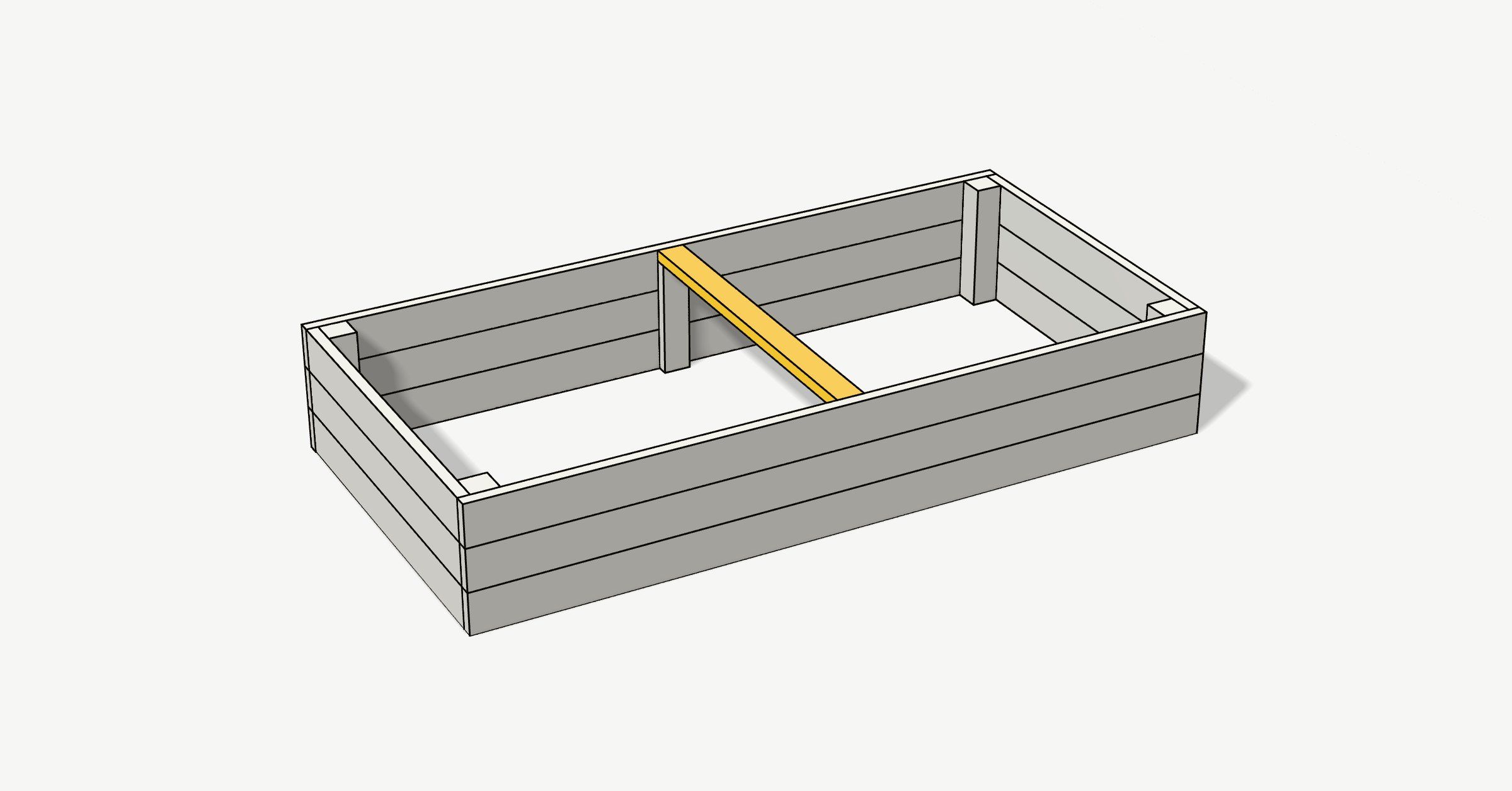
This raised bed is a box of boards three high, 4 feet wide and 8 feet long, so you can reach the middle from either side. The long sides are whole 8 ft 2x6s, so they need no cutting; the ends are cut two from a board. A post in each corner holds the boards together, and a tie across the middle stops the long sides bowing out when the bed is full of wet soil. The metric version, from 45 × 145 mm boards, is 1200 × 2400 mm.
Loading the model…
Drag the bed to turn it around. The tools along the bottom measure it, pull it apart, a board at a time or all at once, and cut it open, and the parts list names every board. The model is the metric version, so it measures in millimetres.
What you need
- 9 × 8 ft 2x6
- 1 × 8 ft 4x4
- 1 × 8 ft 2x4
- 60 × 2 1/2 in exterior wood screws, for the boards
- 8 × 3 in exterior wood screws, for the tie
- About 39 cubic feet of soil to fill it to the top
- Wire mesh for the bottom, if moles or gophers dig in your garden
- 9 × 2.4 m board, 45 × 145 mm
- 1 × 2.4 m post, 70 × 70 mm
- 1 × 2.4 m stud, 45 × 95 mm
- 60 × 5 × 80 mm exterior wood screws, for the boards
- 8 × 5 × 100 mm exterior wood screws, for the tie
- About 1,100 litres of soil to fill it to the top
- Wire mesh for the bottom, if moles or gophers dig in your garden
Use screws made for outdoors (coated or stainless), or they’ll rust in the wet soil and stain the wood. The soil figure is the bed filled to the top, less the room the posts take up; it settles over the first weeks, so have a little more for topping up.
For tools:
- A saw: a mitre saw, a circular saw or a handsaw
- A drill with a driver bit, and a drill bit for pilot holes
- A tape measure, a square and a pencil
- A spirit level and a spade, to level the ground
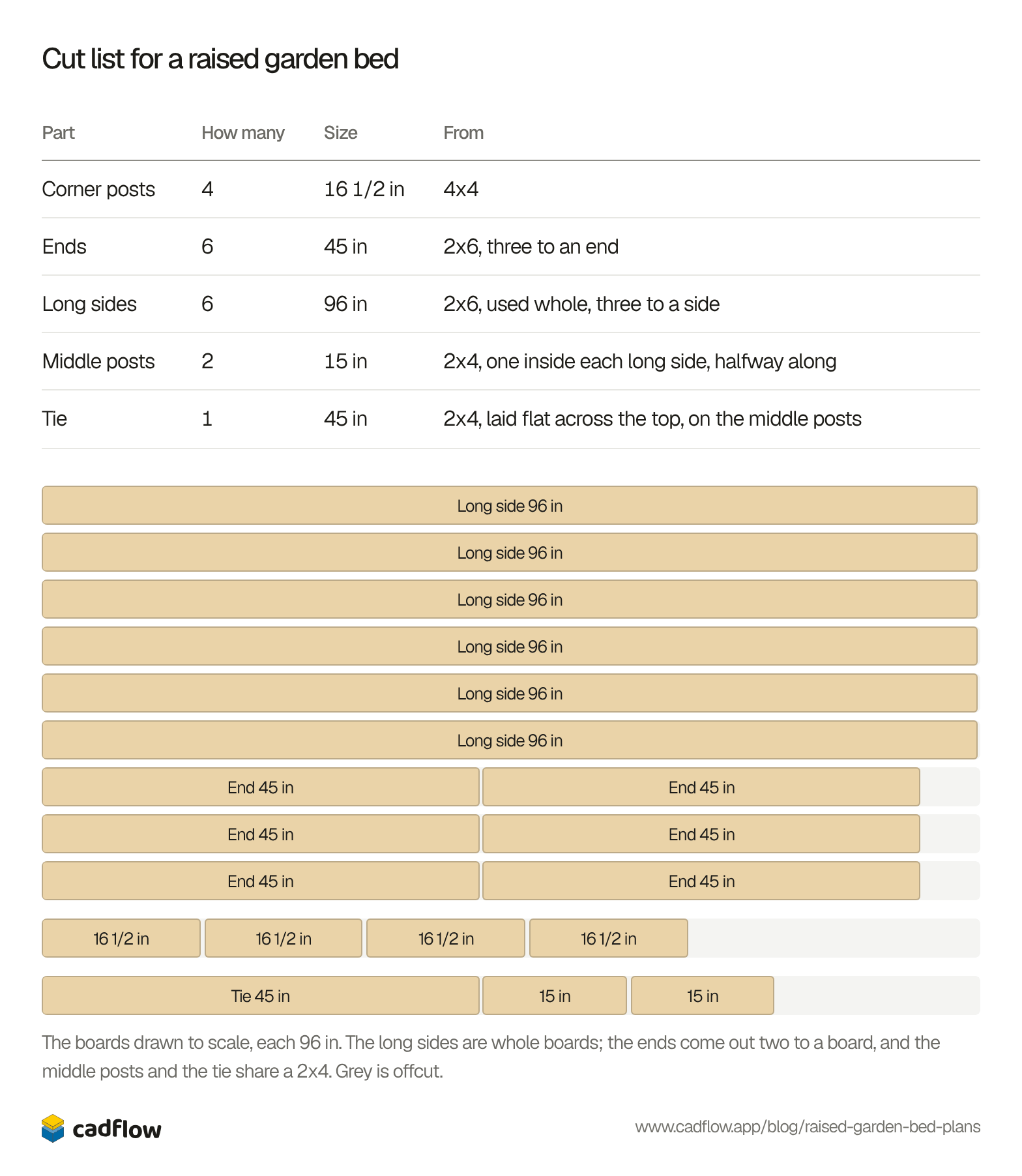
Cut list
| Part | How many | Size | From |
|---|---|---|---|
| Corner posts | 4 | 16 1/2 in | 4x4 |
| Ends | 6 | 45 in | 2x6, three to an end |
| Long sides | 6 | 96 in | 2x6, used whole, three to a side |
| Middle posts | 2 | 15 in | 2x4, one inside each long side, halfway along |
| Tie | 1 | 45 in | 2x4, laid flat across the top, on the middle posts |
The boards drawn to scale, each 96 in. The long sides are whole boards; the ends come out two to a board, and the middle posts and the tie share a 2x4. Grey is offcut.
| Part | How many | Size | From |
|---|---|---|---|
| Corner posts | 4 | 435 mm | 70 × 70 mm post |
| Ends | 6 | 1110 mm | 45 × 145 mm board, three to an end |
| Long sides | 6 | 2400 mm | 45 × 145 mm board, used whole, three to a side |
| Middle posts | 2 | 390 mm | 45 × 95 mm stud, one inside each long side, halfway along |
| Tie | 1 | 1110 mm | 45 × 95 mm stud, laid flat across the top, on the middle posts |
The boards drawn to scale, each 2400 mm. The long sides are whole boards; the ends come out two to a board, and the middle posts and the tie share a 45 × 95 mm stud. Grey is offcut.
Measure your boards before you cut. The plan assumes a 2x6 is 1 1/2 by 5 1/2 inches (or 45 by 145 mm). With other boards, an end is the bed’s width minus two board thicknesses, and the corner posts are as tall as three boards are wide. The middle posts are a tie’s thickness shorter, so the tie can rest on them flush with the top.
Which wood to use
A raised bed sits on wet ground and holds wet soil, so the wood decides how long it lasts. Cedar, larch and Douglas fir resist rot better than pine or spruce left untreated, and cost more. Pressure-treated boards last longest. The copper-based treatments sold now replaced the arsenic-based CCA, which the EPA ended for residential use at the end of 2003; don’t reuse old treated lumber of unknown age for a vegetable bed. If you’d rather keep treated wood away from the soil, staple a plastic liner to the inside of the boards, leaving the bottom open so water drains.
How to build it
1. Build the two ends
Lay two corner posts on a flat floor or patio, an end’s length apart. Lay three end boards across them, the bottom board flush with the posts’ ends and each board tight against the next, so the top board ends flush with the posts’ other end. Check that it’s square, drill pilot holes and drive two screws through each board into each post. Build the other end the same way.
2. Join them with the long sides
Stand the two ends up, a long board’s length apart. Hold the bottom long board against the posts, its end flush with the outside of the end boards, and screw it to both posts with two screws at each end. A second person, or a clamp on each post, makes this much easier. Add the two boards above it, then turn the bed around and do the other side.
3. Add the middle posts
Measure to the middle of each long side and mark it. Stand a middle post on edge against the inside of the long side, centred on the mark, its foot flush with the bottom. Screw through each of the three boards into it. Its top is a tie’s thickness below the top of the bed.
4. Fit the tie
Lay the tie flat across the bed, its ends resting on the two middle posts. It fits between the long sides, flush with their top edges. Screw through each long side into the end of the tie, and down through the tie into each post.
5. Set it in place
Pick a spot with sun for most of the day. Lay the bed where it goes and mark around it with the spade, then lift it off and dig the strip under the bottom boards until it’s level: check across the corners with a spirit level on a straight board. If moles or gophers dig in your garden, lay wire mesh across the bottom and fold it up the inside of the boards before you set the bed down.
Filling it
Fill it with a mix sold as raised bed soil, or a mix of topsoil and compost. To save soil in a bed this deep, many gardeners fill the bottom with branches, wood chips or turf turned upside down, which slowly rot down; then the soil above it settles more in the first year, so top it up in spring. Water it well after filling and let it settle for a few days before you plant.
Changing the size
To make it longer or shorter, change the long sides. Past 8 feet (2400 mm), add a second pair of middle posts and a second tie, so no span is longer than 4 feet. To make it narrower, change the ends: keep it no wider than you can reach to the middle of from both sides.
To make it deeper, add a course of boards: the corner and middle posts grow by a board’s width each, and you need three more boards for each course. A fourth 2x6 makes it 22 inches deep (580 mm), which is easier on the back but takes a third more soil. To make it shallower, leave a course out.
Plans like these in CadFlow
We make CadFlow, a 3D program for things you build, which plays the build back as a step-by-step video that anyone can follow. It isn’t public yet. If you'd like to try it, join the waitlist.
Questions people ask
How deep should a raised garden bed be?
This one is 16 1/2 inches (435 mm), three boards high, which is deep enough for most vegetables, including root crops like carrots. Over good ground, the roots can carry on into the soil below. On a patio or over poor ground, a fourth board makes it deeper.
Should a raised bed have a bottom?
No, leave it open so water drains and roots and worms can reach the ground. Lay wire mesh across the bottom if moles or gophers dig in your garden; it keeps them out and lets water through.
Why does it need a tie across the middle?
Wet soil pushes outward, and an 8 foot board held only at its ends bows out in the middle. The middle posts stiffen each side, and the tie between them holds the two sides together, so neither can move.
Can I use deck boards or 2x8s instead?
Yes. The ends are always the bed's width minus two board thicknesses, and the posts are as tall as the boards stacked. Thinner boards, such as 1 inch (25 mm) deck boards, bow more, so give them more middle posts and ties, closer together.
History of this post
- Published
Read next
30 types of wood for building and furniture, compared
2x4 workbench plans: a sturdy bench from six boards and a sheet of plywood
Tap drill size chart and calculator for every thread


This blog is by the team making CadFlow, where you build your project in 3D and show how it goes together.
See how CadFlow works