Metric bolt size chart: spanner and hex key sizes, M2 to M24
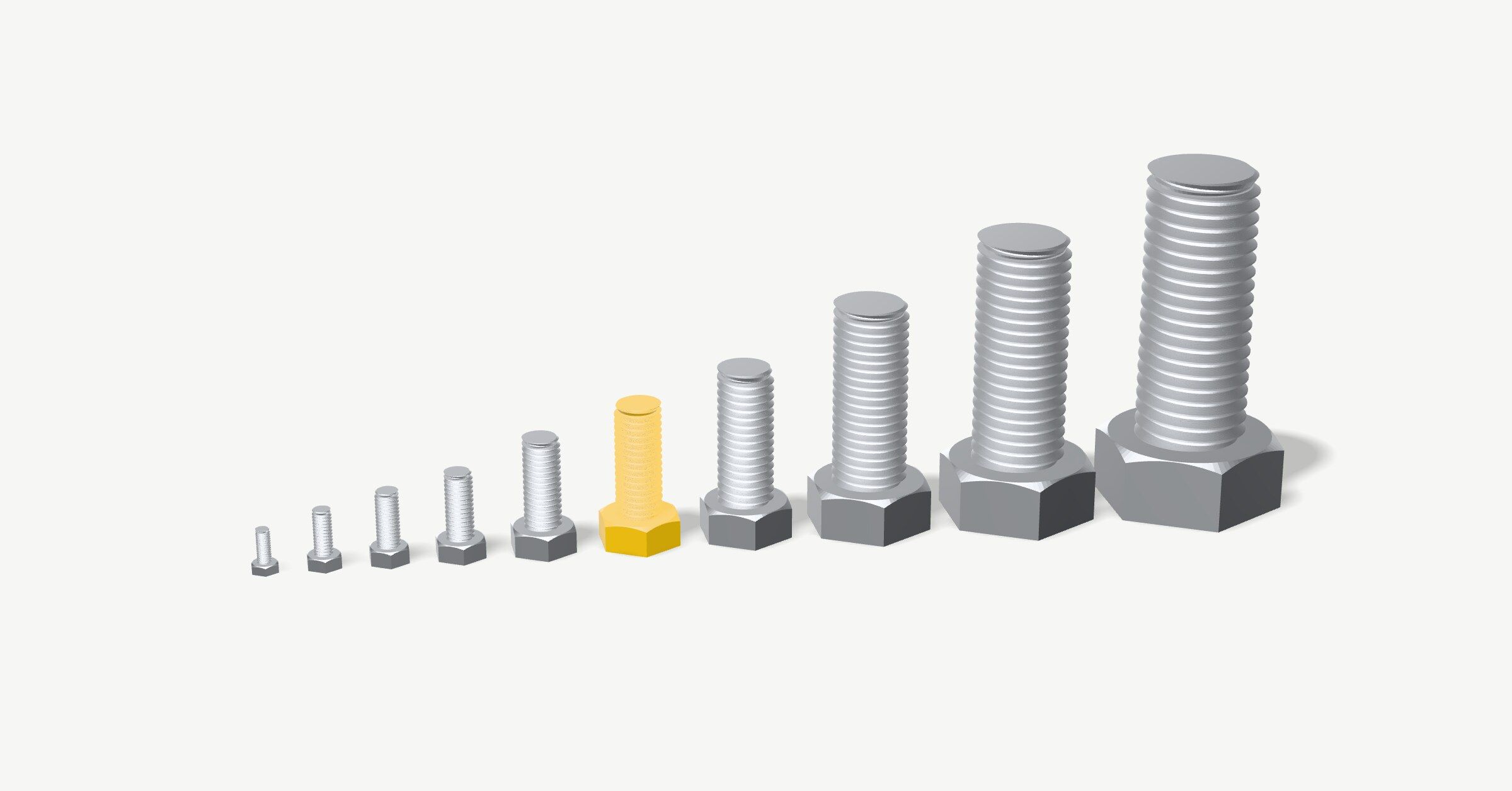
This page answers the questions that come up with a bolt in your hand: which spanner or hex key fits it, and what size hole to drill for it. The ones people ask most: M6 takes a 10 mm spanner, M8 13 mm, M10 16 mm (17 mm if it’s made to DIN 933), M12 18 mm (19 mm for DIN), M16 24 mm, M20 30 mm and M24 36 mm. Pick a size for everything else about it. The full tables are below, all in millimetres, with a chart that goes from the spanner to the bolt, and the heads, nuts and washers too.
- Spanner
- 4 mm
- Hex key, socket head
- 1.5 mm
- Hole for it to pass through
- 2.4 mm
- Tap drill
- 1.6 mm
M2 × 0.4 is the standard thread.
- Spanner
- 5 mm
- Hex key, socket head
- 2 mm
- Hole for it to pass through
- 2.9 mm
- Tap drill
- 2.05 mm
M2.5 × 0.45 is the standard thread.
- Spanner
- 5.5 mm
- Hex key, socket head
- 2.5 mm
- Hole for it to pass through
- 3.4 mm
- Tap drill
- 2.5 mm
M3 × 0.5 is the standard thread.
- Spanner
- 7 mm
- Hex key, socket head
- 3 mm
- Hole for it to pass through
- 4.5 mm
- Tap drill
- 3.3 mm
M4 × 0.7 is the standard thread.
- Spanner
- 8 mm
- Hex key, socket head
- 4 mm
- Hole for it to pass through
- 5.5 mm
- Tap drill
- 4.2 mm
M5 × 0.8 is the standard thread.
- Spanner
- 10 mm
- Hex key, socket head
- 5 mm
- Hole for it to pass through
- 6.6 mm
- Tap drill
- 5.0 mm
M6 × 1 is the standard thread.
- Spanner
- 13 mm
- Hex key, socket head
- 6 mm
- Hole for it to pass through
- 9 mm
- Tap drill
- 6.8 mm
M8 × 1.25 is the standard thread; fine threads are M8 × 1.
- Spanner
- 16 mm (DIN: 17 mm)
- Hex key, socket head
- 8 mm
- Hole for it to pass through
- 11 mm
- Tap drill
- 8.5 mm
M10 × 1.5 is the standard thread; fine threads are M10 × 1.25 and M10 × 1.
- Spanner
- 18 mm (DIN: 19 mm)
- Hex key, socket head
- 10 mm
- Hole for it to pass through
- 13.5 mm
- Tap drill
- 10.2 mm
M12 × 1.75 is the standard thread; fine threads are M12 × 1.5 and M12 × 1.25.
- Spanner
- 21 mm (DIN: 22 mm)
- Hex key, socket head
- 12 mm
- Hole for it to pass through
- 15.5 mm
- Tap drill
- 12.0 mm
M14 × 2 is the standard thread; fine threads are M14 × 1.5.
- Spanner
- 24 mm
- Hex key, socket head
- 14 mm
- Hole for it to pass through
- 17.5 mm
- Tap drill
- 14.0 mm
M16 × 2 is the standard thread; fine threads are M16 × 1.5.
- Spanner
- 27 mm
- Hex key, socket head
- 14 mm
- Hole for it to pass through
- 20 mm
- Tap drill
- 15.5 mm
M18 × 2.5 is the standard thread; fine threads are M18 × 2 and M18 × 1.5.
- Spanner
- 30 mm
- Hex key, socket head
- 17 mm
- Hole for it to pass through
- 22 mm
- Tap drill
- 17.5 mm
M20 × 2.5 is the standard thread; fine threads are M20 × 2 and M20 × 1.5.
- Spanner
- 34 mm (DIN: 32 mm)
- Hex key, socket head
- 17 mm
- Hole for it to pass through
- 24 mm
- Tap drill
- 19.5 mm
M22 × 2.5 is the standard thread; fine threads are M22 × 2 and M22 × 1.5.
- Spanner
- 36 mm
- Hex key, socket head
- 19 mm
- Hole for it to pass through
- 26 mm
- Tap drill
- 21.0 mm
M24 × 3 is the standard thread; fine threads are M24 × 2.
The full chart
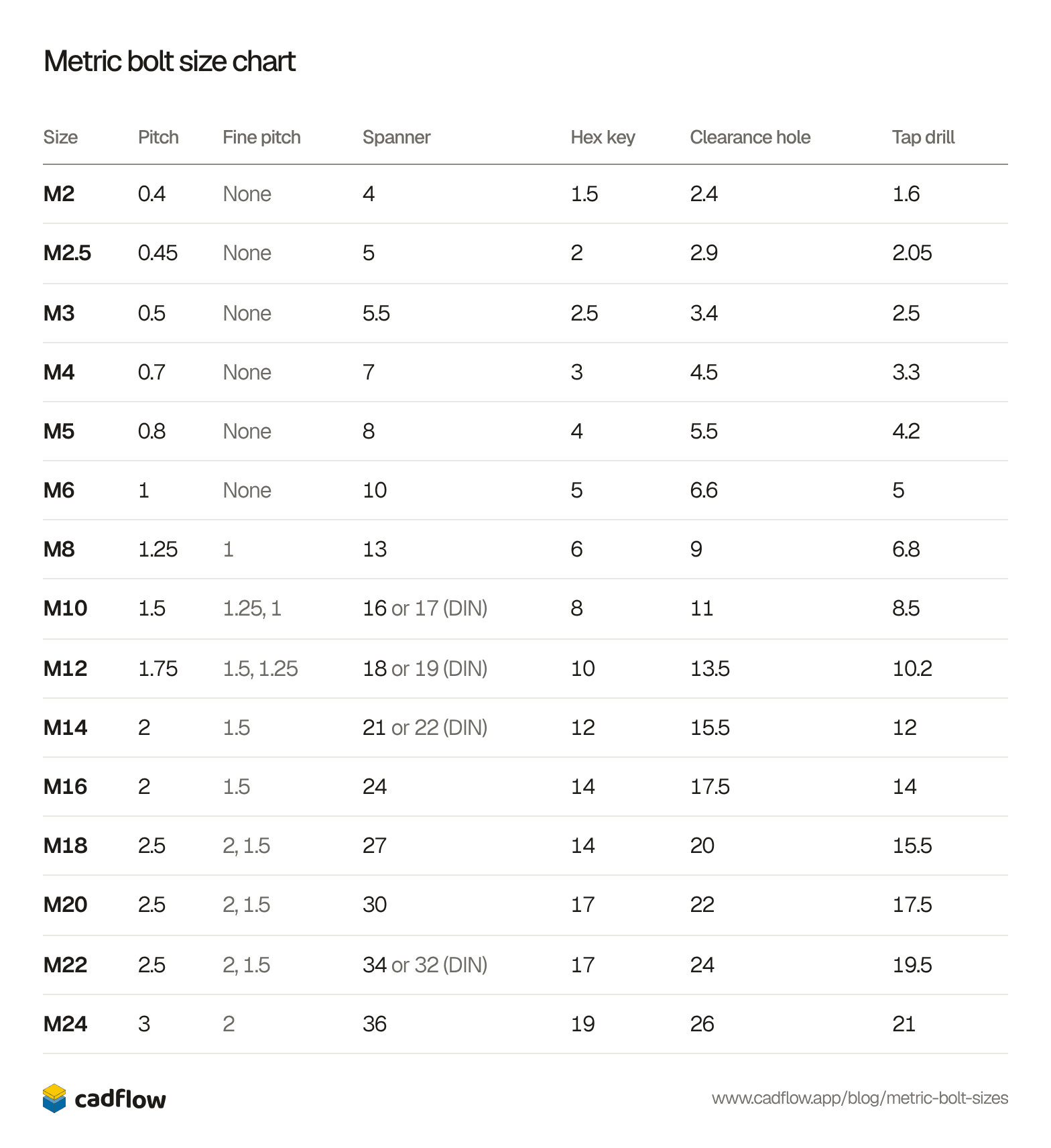
The pitch is the standard thread, the one you get when a bolt is just called M8 or M10. The clearance hole is the medium size from ISO 273, which suits most work, and the tap drill is the same as in our thread calculator.
| Size | Pitch | Fine pitch | Spanner | Hex key | Clearance hole | Tap drill |
|---|---|---|---|---|---|---|
| M2 | 0.4 | None | 4 | 1.5 | 2.4 | 1.6 |
| M2.5 | 0.45 | None | 5 | 2 | 2.9 | 2.05 |
| M3 | 0.5 | None | 5.5 | 2.5 | 3.4 | 2.5 |
| M4 | 0.7 | None | 7 | 3 | 4.5 | 3.3 |
| M5 | 0.8 | None | 8 | 4 | 5.5 | 4.2 |
| M6 | 1 | None | 10 | 5 | 6.6 | 5 |
| M8 | 1.25 | 1 | 13 | 6 | 9 | 6.8 |
| M10 | 1.5 | 1.25, 1 | 16 or 17 (DIN) | 8 | 11 | 8.5 |
| M12 | 1.75 | 1.5, 1.25 | 18 or 19 (DIN) | 10 | 13.5 | 10.2 |
| M14 | 2 | 1.5 | 21 or 22 (DIN) | 12 | 15.5 | 12 |
| M16 | 2 | 1.5 | 24 | 14 | 17.5 | 14 |
| M18 | 2.5 | 2, 1.5 | 27 | 14 | 20 | 15.5 |
| M20 | 2.5 | 2, 1.5 | 30 | 17 | 22 | 17.5 |
| M22 | 2.5 | 2, 1.5 | 34 or 32 (DIN) | 17 | 24 | 19.5 |
| M24 | 3 | 2 | 36 | 19 | 26 | 21 |
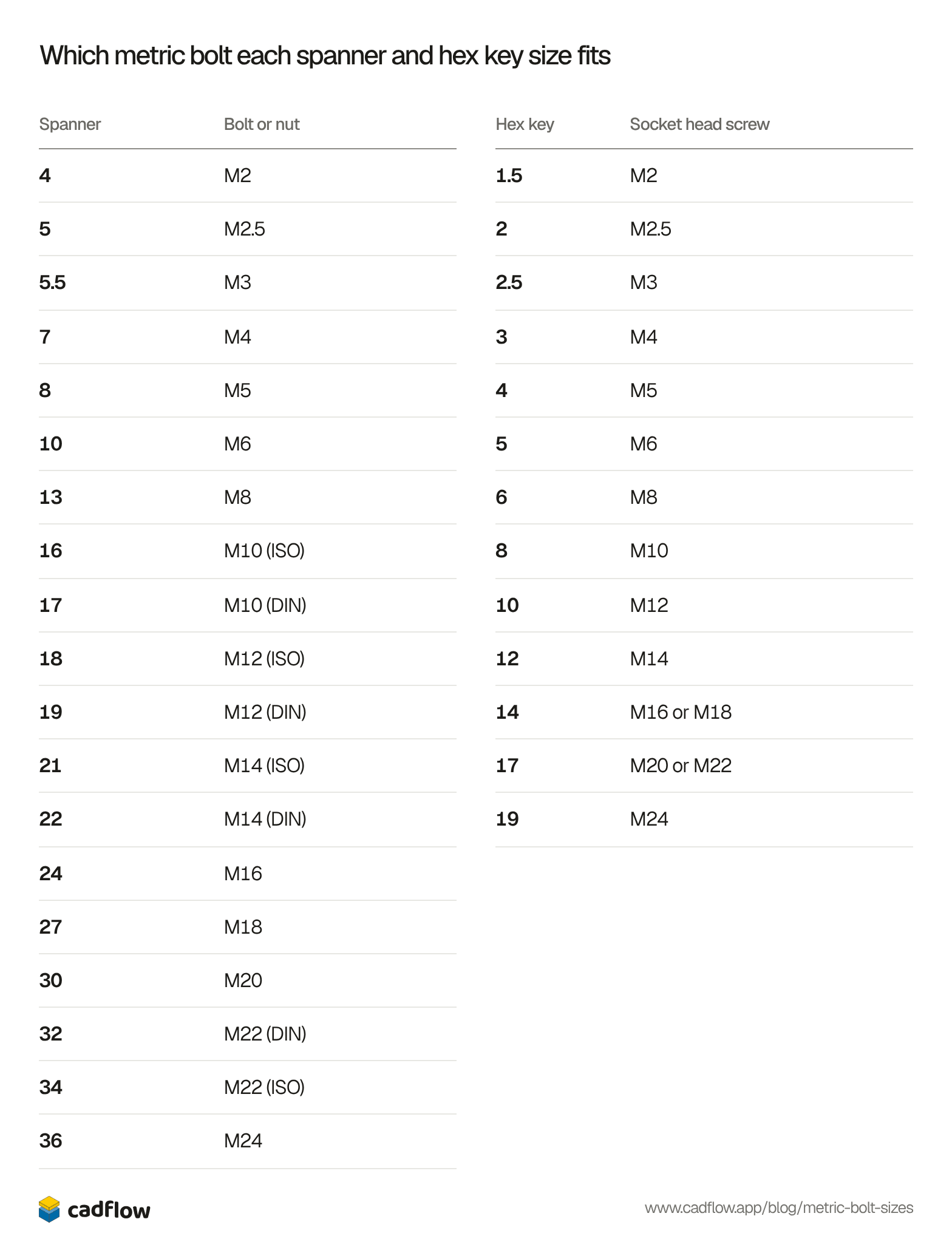
Which bolt fits my spanner?
The same chart the other way round, from the spanner or hex key in your hand to the bolt it fits. A nut takes the same spanner as its bolt. Where a spanner says ISO or DIN, it only fits bolts made to that standard, which the next section explains. To look one up with the spanner in your hand, use our spanner size finder.
| Spanner | Bolt or nut |
|---|---|
| 4 | M2 |
| 5 | M2.5 |
| 5.5 | M3 |
| 7 | M4 |
| 8 | M5 |
| 10 | M6 |
| 13 | M8 |
| 16 | M10 (ISO) |
| 17 | M10 (DIN) |
| 18 | M12 (ISO) |
| 19 | M12 (DIN) |
| 21 | M14 (ISO) |
| 22 | M14 (DIN) |
| 24 | M16 |
| 27 | M18 |
| 30 | M20 |
| 32 | M22 (DIN) |
| 34 | M22 (ISO) |
| 36 | M24 |
| Hex key | Socket head screw |
|---|---|
| 1.5 | M2 |
| 2 | M2.5 |
| 2.5 | M3 |
| 3 | M4 |
| 4 | M5 |
| 5 | M6 |
| 6 | M8 |
| 8 | M10 |
| 10 | M12 |
| 12 | M14 |
| 14 | M16 or M18 |
| 17 | M20 or M22 |
| 19 | M24 |
Why a 17 mm spanner doesn’t fit every M10 bolt
Two seperate standards describe the same hex bolts. The older German one, DIN 933 (DIN 931 for bolts with a plain shank), puts a 17 mm hex on an M10 bolt. ISO 4017 and ISO 4014, which replaced them, make it 16 mm. The same happens at M12, which is 19 mm in DIN and 18 mm in ISO, and at M14, 22 against 21 mm. At M22 it goes the other way, 32 mm in DIN and 34 mm in ISO. Every other size is the same in both.
Both kinds are still sold, so if your 17 mm spanner slips on a new M10 bolt, the bolt is made to ISO and needs a 16. Nuts follow the bolts: DIN 934 nuts take the DIN sizes and ISO 4032 nuts the ISO ones.
Clearance holes: fine, medium or coarse
ISO 273 gives three hole sizes for each bolt. The medium hole suits most things, because it leaves a little room to line two parts up. Use the fine hole when parts have to sit exactly in place and you drill them together or with a jig, and the coarse hole when you can’t drill both parts accurately, such as a bracket going onto a wall.
| Size | Fine | Medium | Coarse |
|---|---|---|---|
| M2 | 2.2 | 2.4 | 2.6 |
| M2.5 | 2.7 | 2.9 | 3.1 |
| M3 | 3.2 | 3.4 | 3.6 |
| M4 | 4.3 | 4.5 | 4.8 |
| M5 | 5.3 | 5.5 | 5.8 |
| M6 | 6.4 | 6.6 | 7 |
| M8 | 8.4 | 9 | 10 |
| M10 | 10.5 | 11 | 12 |
| M12 | 13 | 13.5 | 14.5 |
| M14 | 15 | 15.5 | 16.5 |
| M16 | 17 | 17.5 | 18.5 |
| M18 | 19 | 20 | 21 |
| M20 | 21 | 22 | 24 |
| M22 | 23 | 24 | 26 |
| M24 | 25 | 26 | 28 |
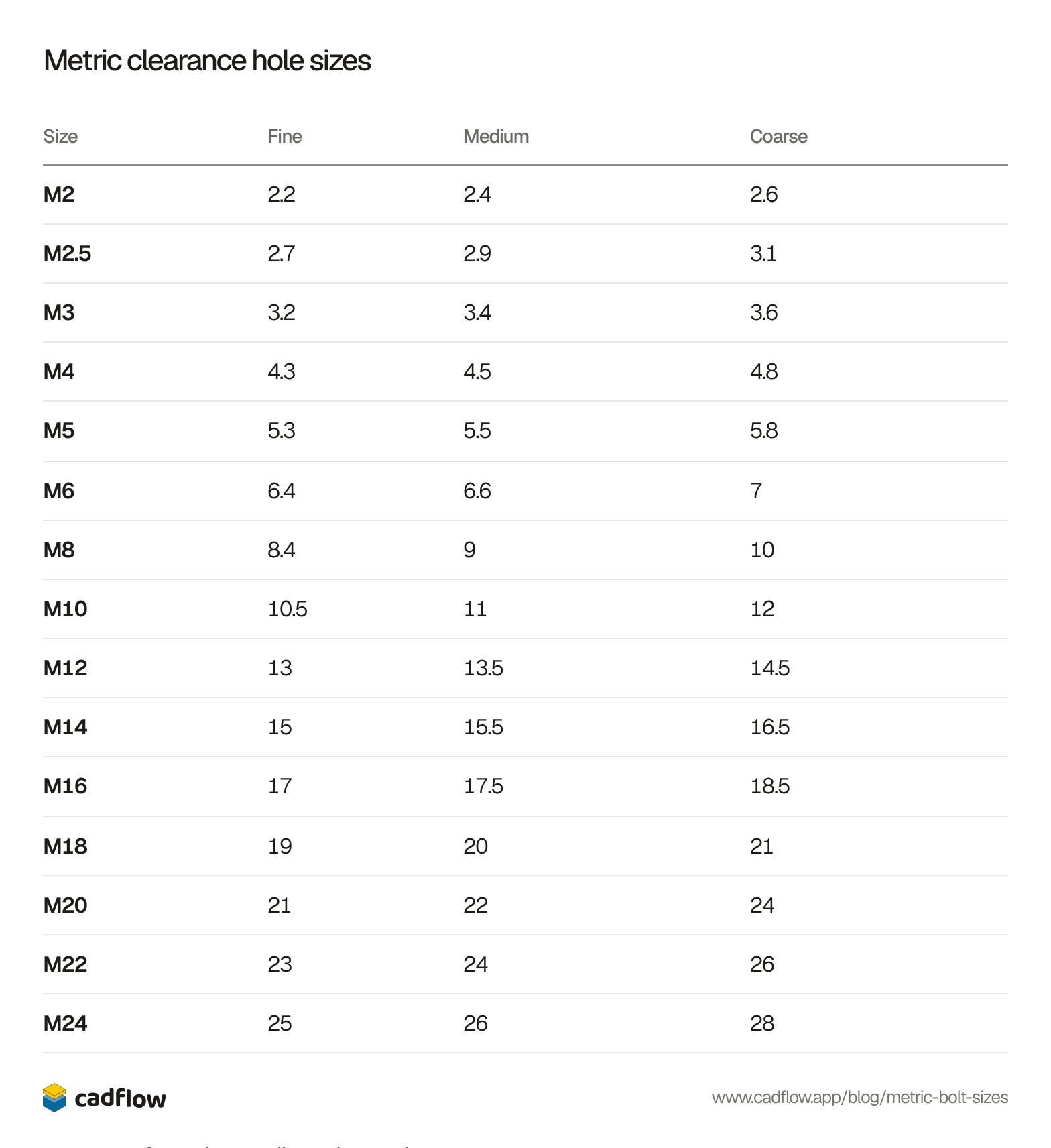
Holes in 3D printed parts usually come out a little smaller than they’re drawn, so in a printed part start from the medium size and test.
Heads, nuts and washers
Socket heads and nuts are given at their largest, so a counterbore or a pocket made to these sizes fits any screw or nut that meets the standard. Hex head heights are the nominal size, and washers are the smallest hole and the largest outside the standard allows.
| Size | Hex head height | Socket head, across × high | Nut height, ISO | Nut height, DIN | Washer, inside × outside × thick |
|---|---|---|---|---|---|
| M2 | 1.4 | 3.8 × 2 | 1.6 | 1.6 | 2.2 × 5 × 0.3 |
| M2.5 | 1.7 | 4.5 × 2.5 | 2 | 2 | 2.7 × 6 × 0.5 |
| M3 | 2 | 5.5 × 3 | 2.4 | 2.4 | 3.2 × 7 × 0.5 |
| M4 | 2.8 | 7 × 4 | 3.2 | 3.2 | 4.3 × 9 × 0.8 |
| M5 | 3.5 | 8.5 × 5 | 4.7 | 4 | 5.3 × 10 × 1 |
| M6 | 4 | 10 × 6 | 5.2 | 5 | 6.4 × 12 × 1.6 |
| M8 | 5.3 | 13 × 8 | 6.8 | 6.5 | 8.4 × 16 × 1.6 |
| M10 | 6.4 | 16 × 10 | 8.4 | 8 | 10.5 × 20 × 2 |
| M12 | 7.5 | 18 × 12 | 10.8 | 10 | 13 × 24 × 2.5 |
| M14 | 8.8 | 21 × 14 | 12.8 | 11 | 15 × 28 × 2.5 |
| M16 | 10 | 24 × 16 | 14.8 | 13 | 17 × 30 × 3 |
| M18 | 11.5 | 27 × 18 | 15.8 | 15 | 19 × 34 × 3 |
| M20 | 12.5 | 30 × 20 | 18 | 16 | 21 × 37 × 3 |
| M22 | 14 | 33 × 22 | 19.4 | 18 | 23 × 39 × 3 |
| M24 | 15 | 36 × 24 | 21.5 | 19 | 25 × 44 × 4 |
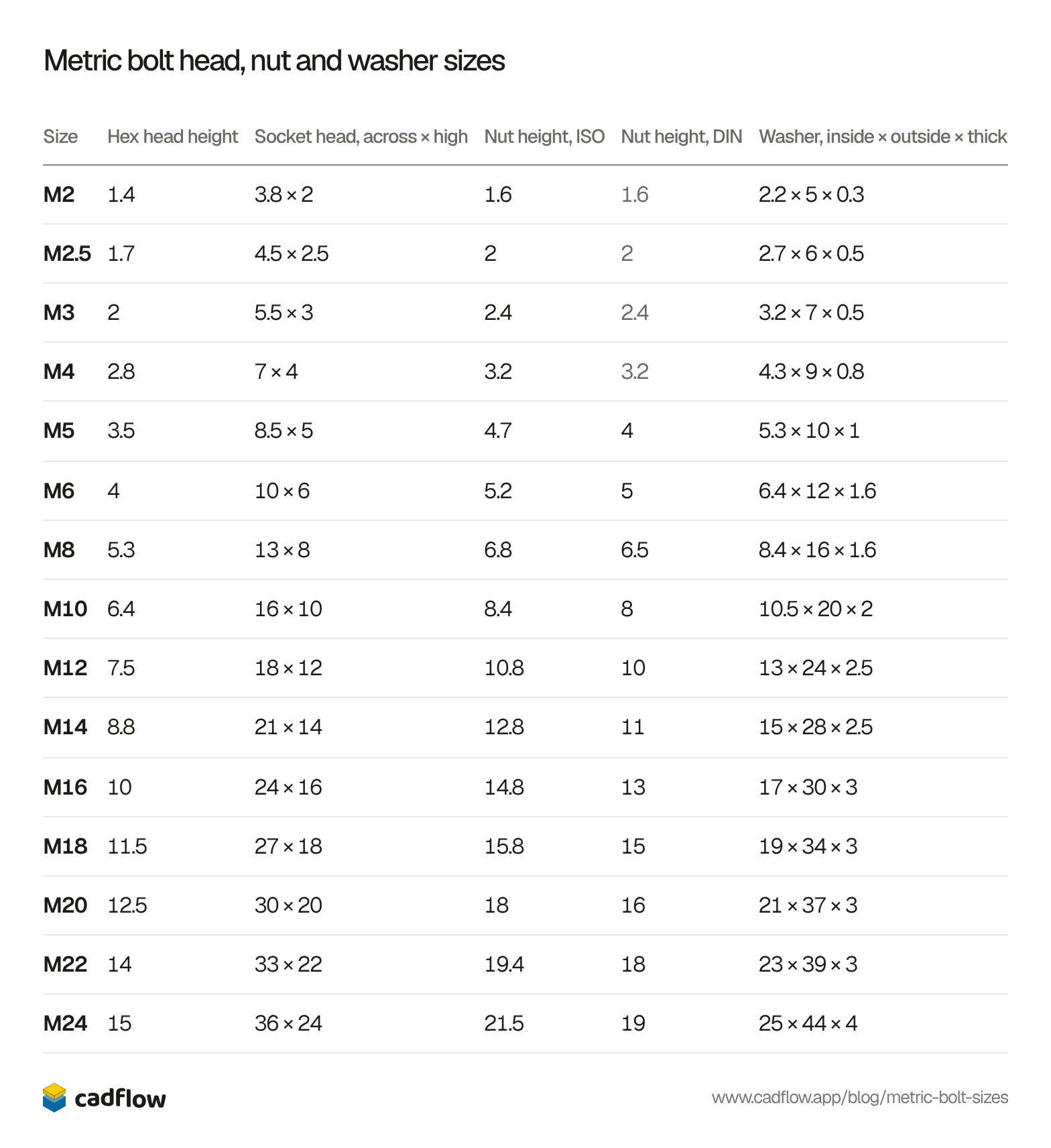
From M5 up, a DIN 934 nut is a little lower than an ISO 4032 nut of the same size, for example 8 mm against 8.4 mm at M10.
Parts like these in CadFlow
We make CadFlow, a 3D program for things you build, which plays the build back as a step-by-step video that anyone can follow. It isn’t public yet. If you'd like to try it, join the waitlist.
Questions people ask
What size spanner fits an M8 bolt?
13 mm. An M6 bolt takes 10 mm, an M10 takes 16 mm (17 mm if it's made to DIN 933), and an M12 takes 18 mm (19 mm for DIN).
What bolt fits a 24 mm spanner?
M16. A 13 mm spanner fits M8, 17 mm an M10 made to DIN 933, 19 mm an M12 made to DIN, 30 mm M20 and 36 mm M24.
What size hole do I drill for an M6 bolt?
6.6 mm for the bolt to pass through, the medium size in ISO 273. The fine size is 6.4 mm and the coarse 7 mm. To cut an M6 thread in the hole instead, drill 5 mm and tap it.
What hex key fits an M6 socket head screw?
5 mm. M5 takes 4 mm, M8 takes 6 mm and M10 takes 8 mm.
What's the difference between M10 and M10 × 1.25?
M10 on its own means the standard thread, with 1.5 mm from one thread to the next. M10 × 1.25 is a fine thread, with the threads 1.25 mm apart. The bolt and the nut have to match: a fine nut won't go on a standard bolt.
Where do these numbers come from?
From the standards: ISO 261 and ISO 262 for threads, ISO 4014 and ISO 4017 for hex bolts (DIN 931 and DIN 933 for the older sizes), ISO 4762 for socket head cap screws (DIN 912 for M18 and M22, which ISO 4762 leaves out), ISO 4032 and DIN 934 for nuts, ISO 7089 for washers and ISO 273 for clearance holes. We checked every column against at least two published tables on 24 October 2026, and M18 and M22 on 10 November, mainly fasten.it, Fuller Fasteners, AMES and TR Fastenings. The tap drills are ISO 2306's, as in our thread calculator.
Free tools for this
- Spanner size finderThe spanner and hex key for a metric bolt, or the bolt that fits your spanner.
- Tap drill calculatorThe drill for any metric, UNC or UNF tap, coarse and fine threads.
- Pulley system calculatorAdd pulleys, pull the rope, and see how much lighter the load gets and how much more rope you pull. Print the pulleys too.
History of this post
- Updated: The spanner and hex key sizes people ask for most at the top, a chart from the spanner back to the bolt, and M18 and M22 in the tables.
- Published
Read next
Tap drill size chart and calculator for every thread
Tensile and yield strength: steel, aluminium, bolts, wood and plastic
2x4 workbench plans: a sturdy bench from six boards and a sheet of plywood


This blog is by the team making CadFlow, where you build your project in 3D and show how it goes together.
See how CadFlow works