Tensile and yield strength: steel, aluminium, bolts, wood and plastic
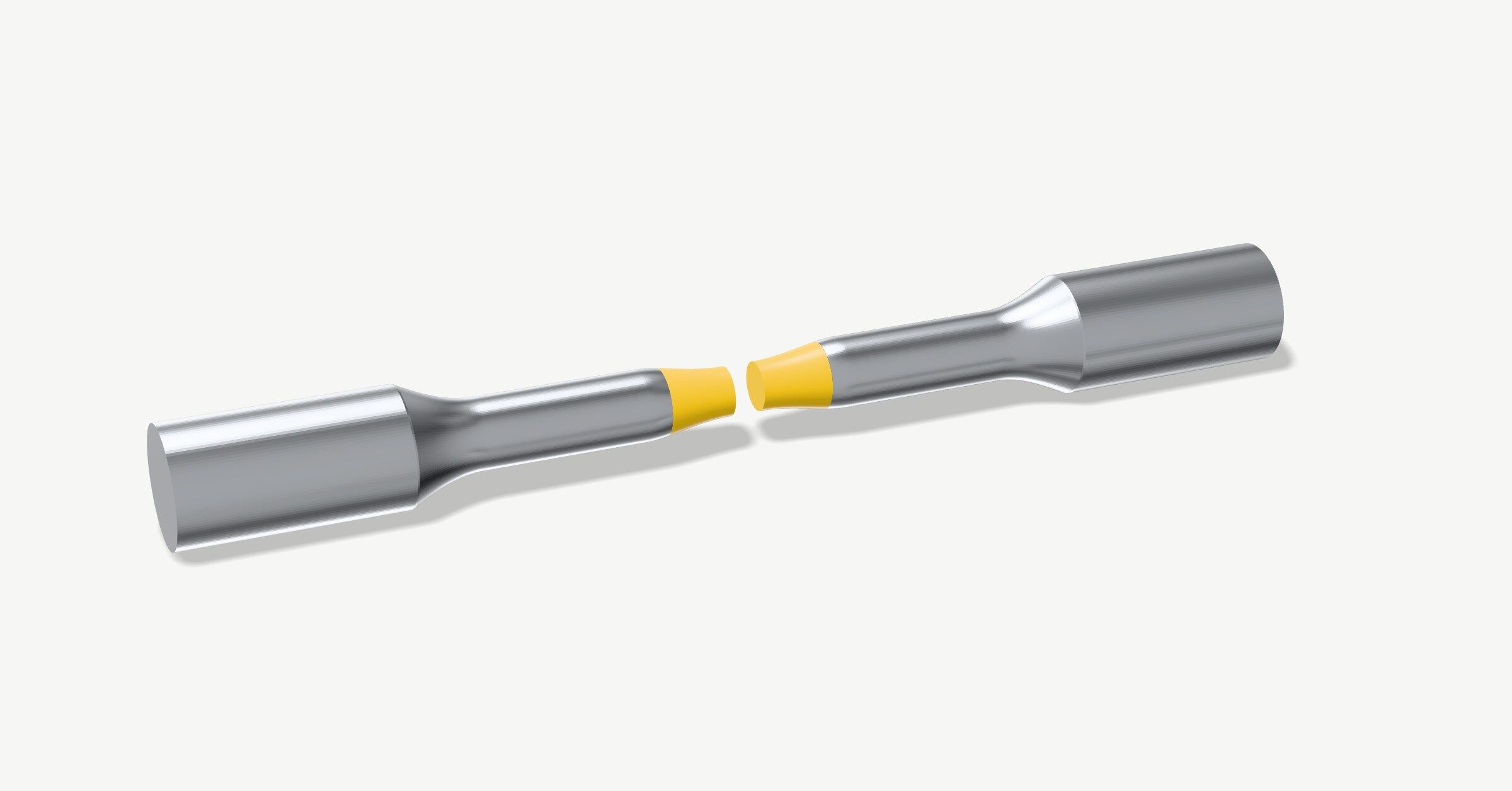
Tensile strength is the most pull a material can take before it breaks. Yield strength is how hard you can pull before it stays stretched once you let go. An 8.8 bolt has a yield strength of 640 MPa and a tensile strength of 800 MPa, while a PLA print gives way at about 52 MPa.
What a megapascal holds
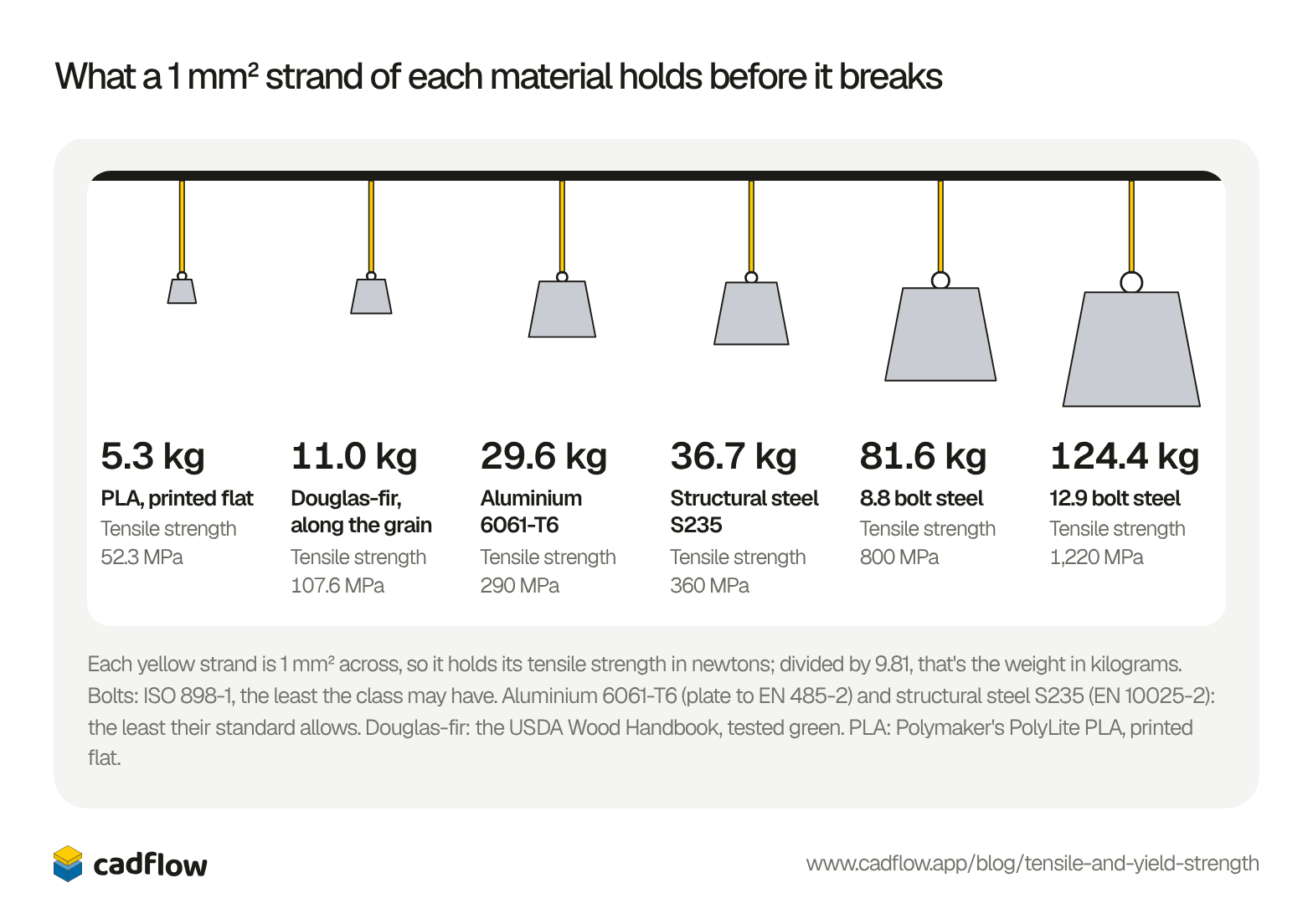
Both strengths are a force divided by the area it pulls on. One megapascal (MPa) is a newton on every square millimetre, the same as 1 N/mm², and a newton is the weight of 102 grams. So a strand one millimetre square holds 102 grams for every MPa of its tensile strength.
5.3 kg
PLA, printed flat
Tensile strength 52.3 MPa
11.0 kg
Douglas-fir, along the grain
Tensile strength 107.6 MPa
29.6 kg
Aluminium 6061-T6
Tensile strength 290 MPa
36.7 kg
Structural steel S235
Tensile strength 360 MPa
81.6 kg
8.8 bolt steel
Tensile strength 800 MPa
124.4 kg
12.9 bolt steel
Tensile strength 1,220 MPa
In the US, strength is given in psi, pounds per square inch, or in ksi, thousands of them. 1 MPa is 145 psi, and 1 ksi is 6.9 MPa.
Tensile strength and yield strength
Pull on a steel test bar and at first it stretches like a stiff spring: let go and it’s as long as before. Past its yield strength it stays longer when you let go. At its tensile strength it starts to thin in one place, the neck, and that’s where it breaks.
1
At rest
0 MPa
Gripped at both ends, not pulled yet
2
Yield strength
640 MPa
Let go now and it stays 0.2 % longer
3
Tensile strength
800 MPa
The most it holds. Now it starts to neck
4
Breaks
12 % longer
than it started, with the two pieces put back together
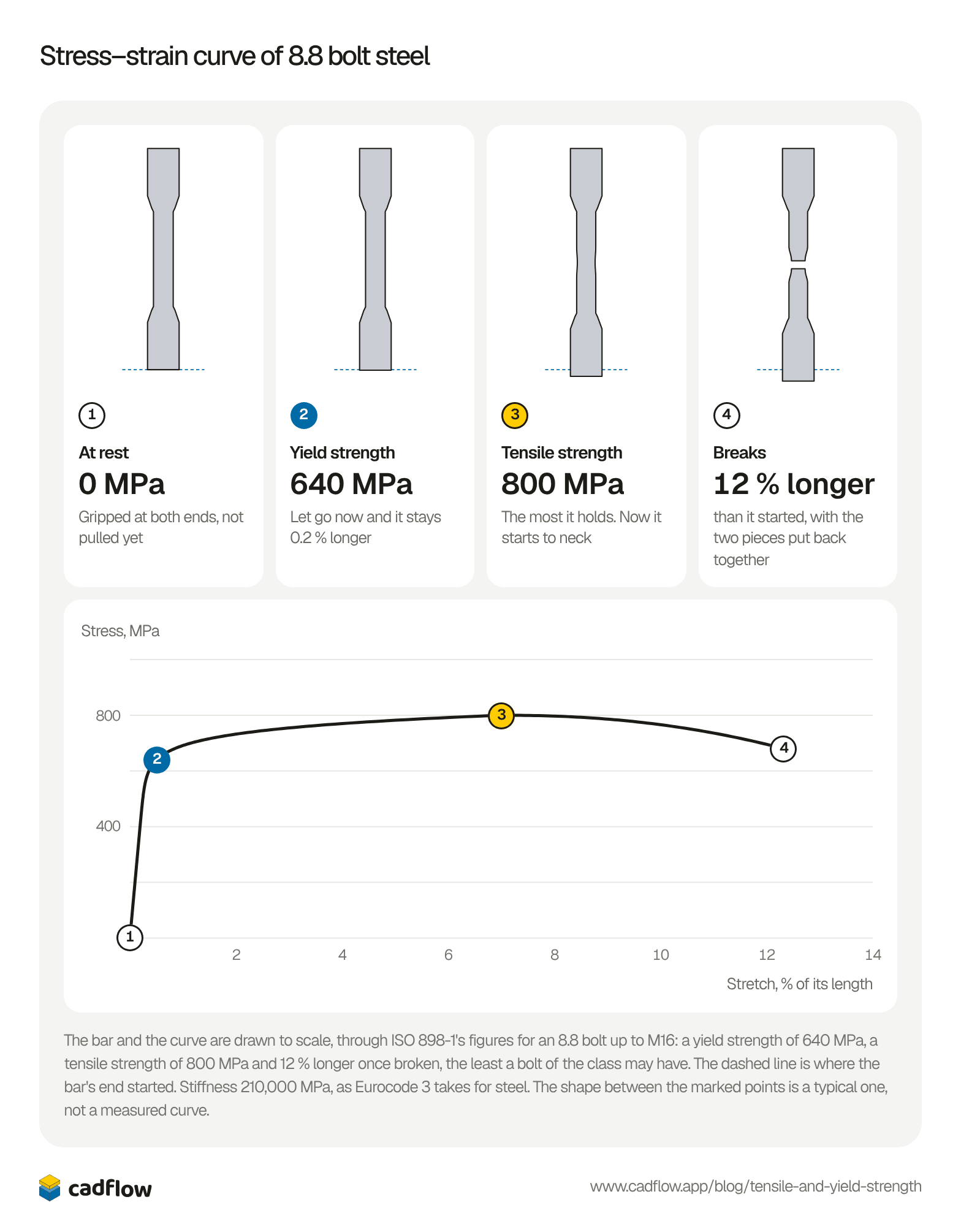
At its yield strength the bar is only half a percent longer, too little to see, which is why the curve starts almost straight up. A part should stay well below its yield strength, because past it the part is bent or stretched for good, even though it hasn’t broken.
Yield and tensile strength of common materials
Metals come with both numbers. The other materials here come with a tensile strength only, as their sources give no yield strength.
Yield strengthTensile strength
Show as a table
| Material | Yield strength | Tensile strength |
|---|---|---|
| 12.9 bolt steel | 1,100 MPa (160 ksi) | 1,220 MPa (177 ksi) |
| Titanium grade 5 | 828 MPa (120 ksi) | 895 MPa (130 ksi) |
| 8.8 bolt steel | 640 MPa (93 ksi) | 800 MPa (116 ksi) |
| Stainless steel 304 | 205 MPa (30 ksi) | 515 MPa (75 ksi) |
| Structural steel S235 | 235 MPa (34 ksi) | 360 MPa (52 ksi) |
| Aluminium 6061-T6 | 240 MPa (35 ksi) | 290 MPa (42 ksi) |
| Douglas-fir, along the grain | Not given | 107.6 MPa (16 ksi) |
| Nylon, printed flat | Not given | 78 MPa (11 ksi) |
| PLA, printed flat | Not given | 52.3 MPa (8 ksi) |
| PETG, printed flat | Not given | 48 MPa (7 ksi) |
| ABS, printed flat | Not given | 33.4 MPa (5 ksi) |
| Concrete C30/37 | Not given | 2.9 MPa (0.42 ksi) |
| Douglas-fir, across the grain | Not given | 2.3 MPa (0.33 ksi) |
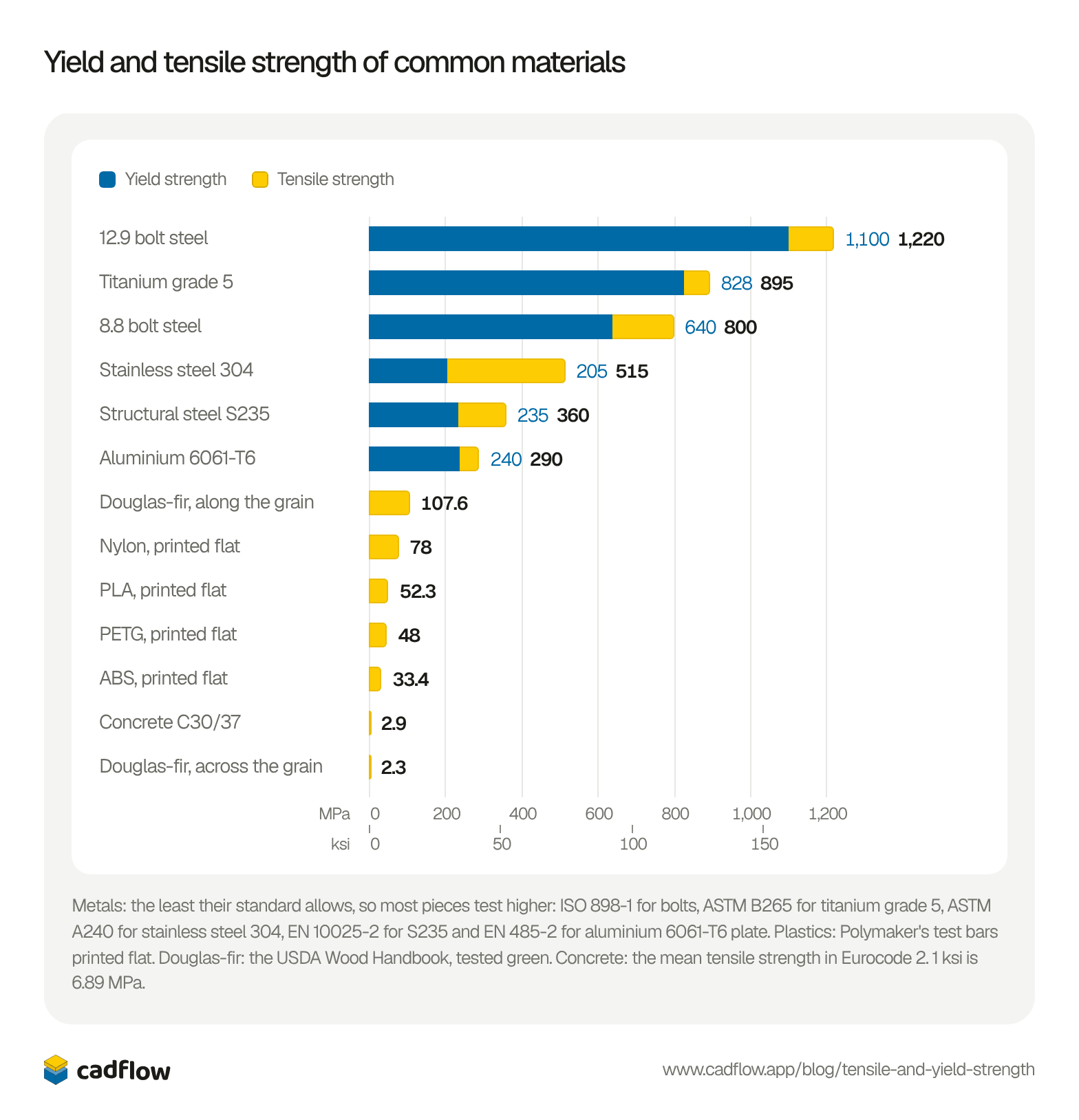
The gap between the two numbers varies a lot from metal to metal. Stainless steel 304 yields at 205 MPa but doesn’t break untill 515, and stretches by at least 40 % on the way. Titanium grade 5 and 12.9 bolt steel yield at 90 % of their tensile strength or more.
What 8.8, 10.9 and 12.9 on a bolt mean
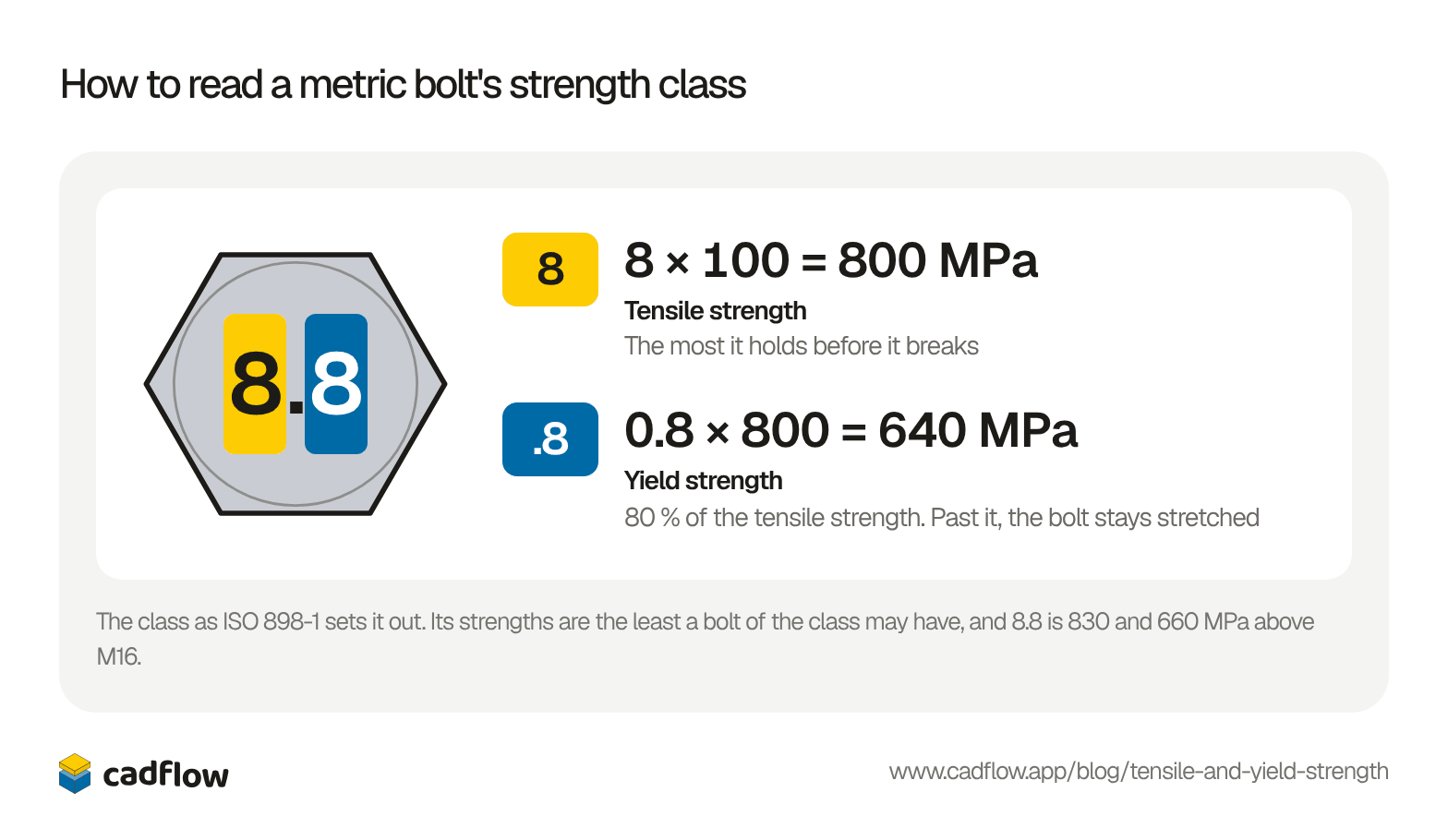
The two numbers on a metric bolt’s head are its property class, set out in ISO 898-1. The first times 100 is the tensile strength in MPa. The second is the yield strength as a share of it.
8.8
8 × 100 = 800 MPa
Tensile strength The most it holds before it breaks
0.8 × 800 = 640 MPa
Yield strength 80 % of the tensile strength. Past it, the bolt stays stretched
Multiplied by the area of the thread, those strengths give the least load a bolt of each class holds. For an M10:
4.6
23.2 kN
the weight of 2.4 t
Yield 240 MPaTensile 400 MPaStretches 22 % before it breaks
8.8
46.4 kN
the weight of 4.7 t
Yield 640 MPaTensile 800 MPaStretches 12 % before it breaks
10.9
60.3 kN
the weight of 6.1 t
Yield 940 MPaTensile 1,040 MPaStretches 9 % before it breaks
12.9
70.8 kN
the weight of 7.2 t
Yield 1,100 MPaTensile 1,220 MPaStretches 8 % before it breaks
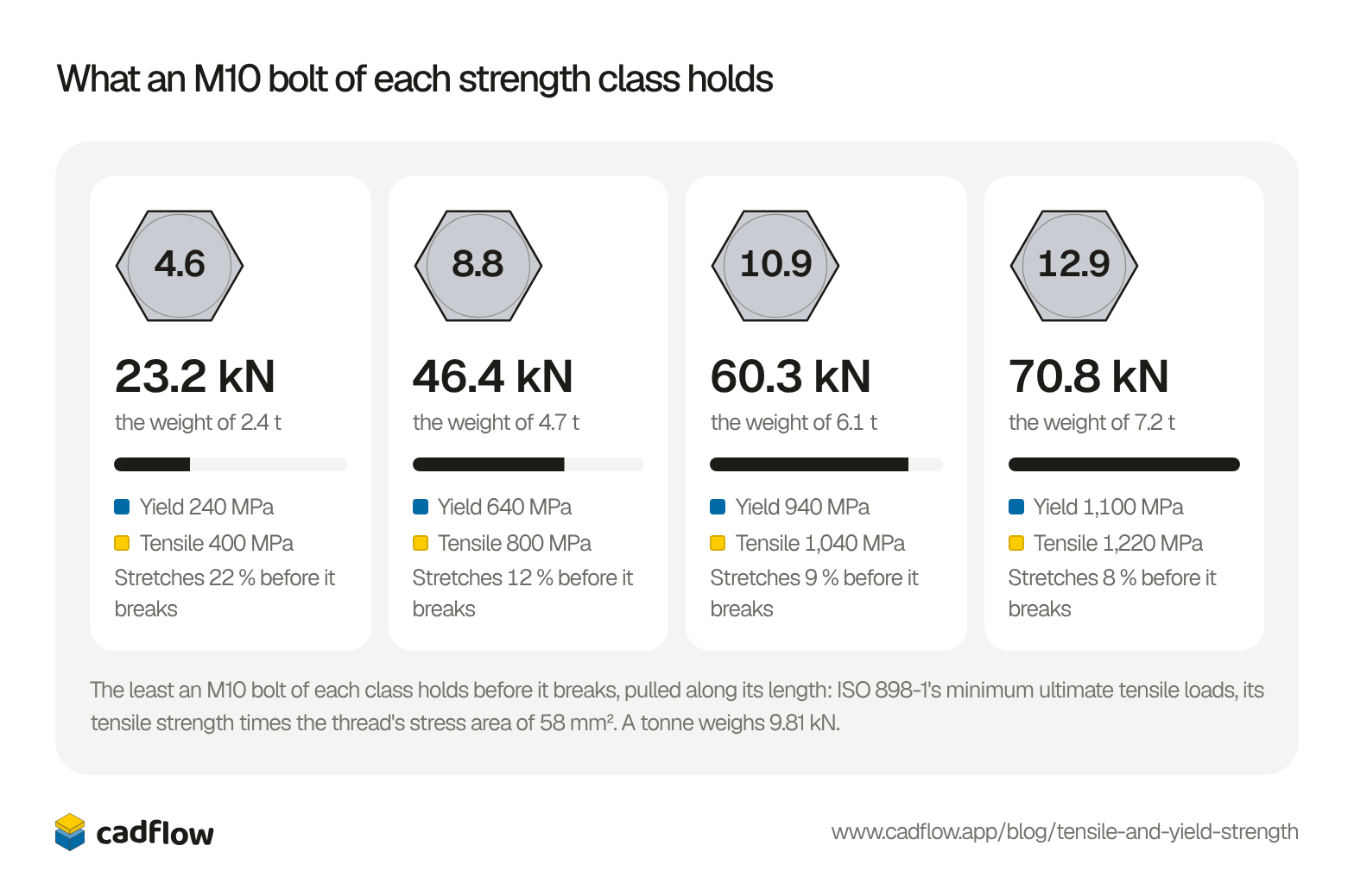
A 12.9 bolt holds about half as much again as an 8.8 of the same size, but it stretches only 8 % before it breaks, against the 8.8’s 12 %. Our metric bolt sizes post has the spanner and hex key for each size.
Strength for its weight
A strand of any material can hang only so far before its own weight breaks it. That length is the tensile strength divided by the material’s weight per volume, so it compares materials kilo for kilo.
20.6 kmTitanium grade 5
20.4 kmDouglas-fir, along the grain
11.0 kmAluminium 6061-T6
10.4 km8.8 bolt steel
4.7 kmStructural steel S235
4.6 kmPLA, printed flat
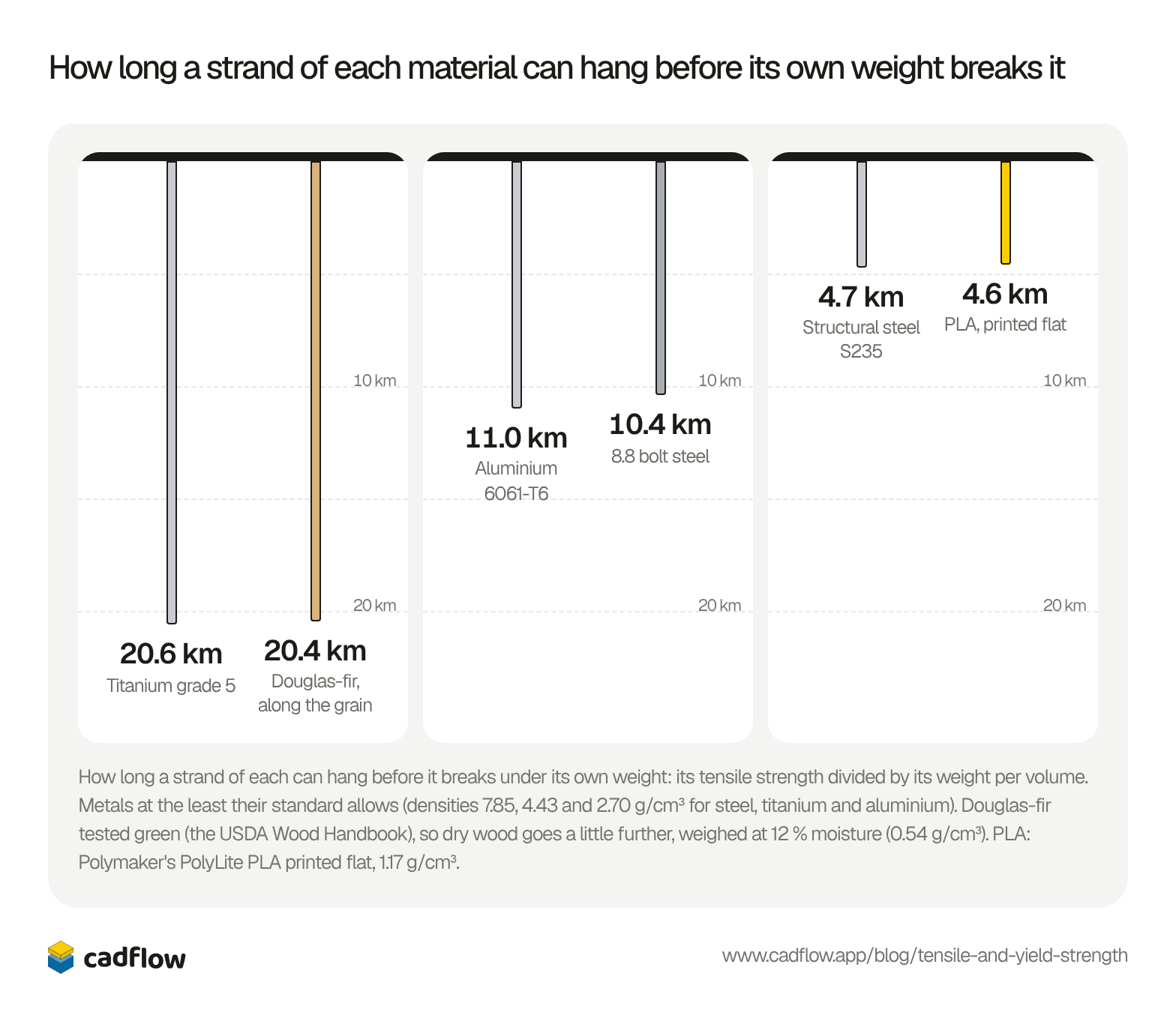
Per kilo, Douglas-fir pulled along its grain holds as much as titanium. Aluminium matches 8.8 bolt steel the same way, and PLA matches S235 structural steel.
Wood and 3D prints are weaker across
Wood’s fibres run along the trunk, and a 3D print is a stack of layers, each fused only to the one below it. Pulled across the grain or across the layers, both give way sooner.
Douglas-fir
107.6 MPa
Along the grain
2.3 MPa
Across the grain
47 times as strong along the grain
PLA, 3D printed
52.3 MPa
Printed flat, pulled along its layers
40.5 MPa
Printed upright, pulled across its layers
Upright it keeps 77 % of its strength
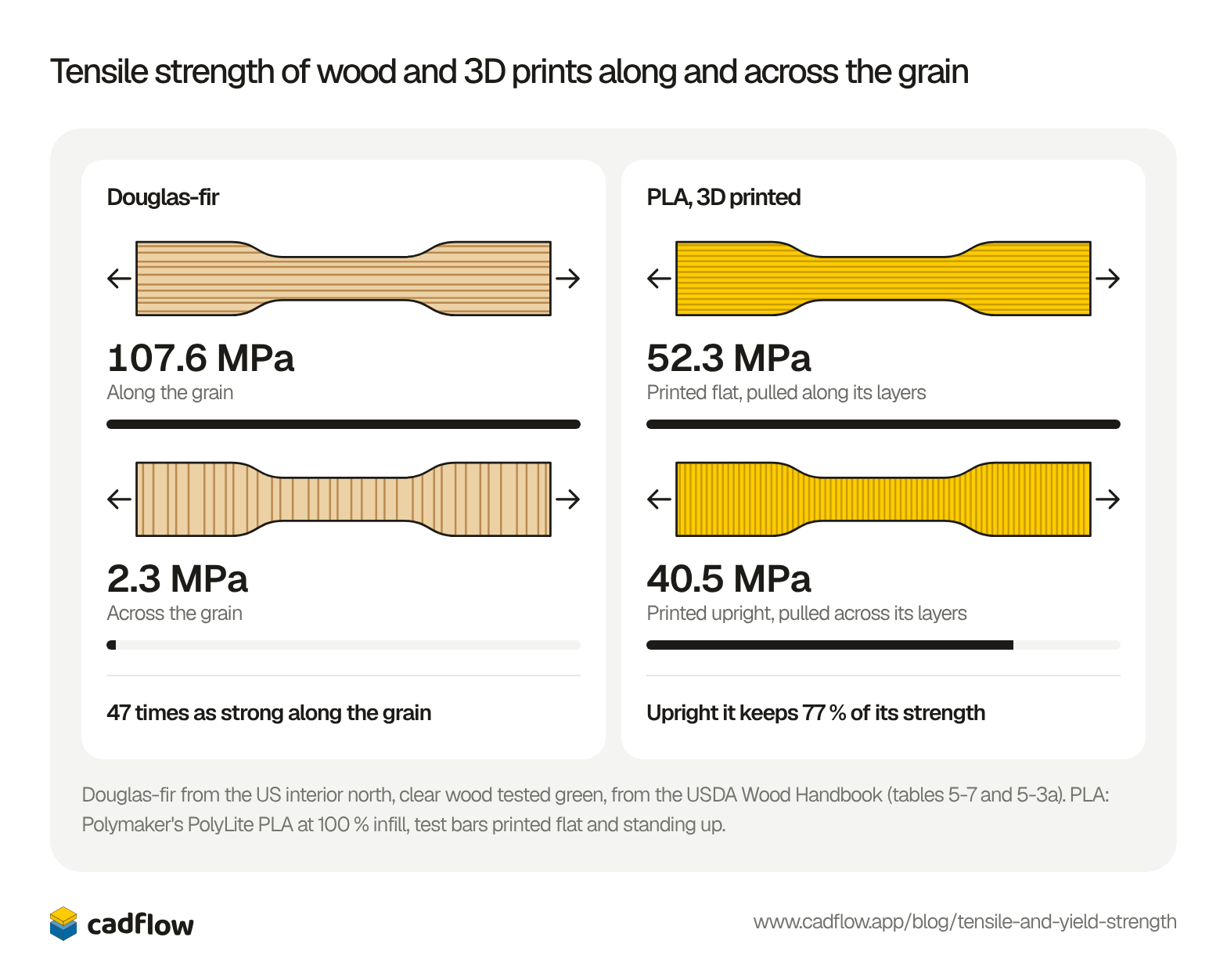
So load wood along its grain, and lay a part on the print bed so the pull runs along its layers. Our filament post has the same test for four other filaments.
About CadFlow
We make CadFlow, a 3D program for things you build, which plays the build back as a step-by-step video that anyone can follow. It isn’t public yet. If you'd like to try it, join the waitlist.
Questions people ask
How do you work out tensile strength?
Divide the highest force in the test by the area the bar had before it was pulled. An M10 bolt's thread has a stress area of 58 mm², so an 8.8 bolt that holds 46,400 N has a tensile strength of 46,400 ÷ 58 = 800 MPa.
How do I convert MPa to psi, ksi or kgf/mm²?
1 MPa is 1 N/mm², 145.04 psi, 0.145 ksi or 0.102 kgf/mm². The other way, 1 ksi is 6.895 MPa and 1 kgf/mm² is 9.807 MPa.
Is ultimate tensile strength the same as tensile strength?
Yes. Ultimate tensile strength (UTS), tensile strength and Rm, the symbol ISO standards use, all mean the highest stress in a tensile test. Yield strength is Re or Rp0.2 in the same standards.
Why is yield strength given at 0.2 %?
Most metals don't stop springing back at one clear point, so the yield strength is read where the bar would stay 0.2 % longer once let go. Mild steel such as S235 is an exception: it gives way at a clear point, written ReH.
What's the difference between tensile and shear strength?
Tensile strength is a pull along the bolt, shear a force across it, as in two plates sliding over each other. Eurocode 3 takes a bolt's shear strength through its thread as 60 % of its tensile strength for classes 4.6, 5.6 and 8.8, and 50 % for 4.8, 5.8, 6.8 and 10.9.
What's the tensile strength of concrete?
Eurocode 2 gives C30/37 concrete a mean tensile strength of 2.9 MPa, about a tenth of the 30 MPa it takes squeezed. That's why concrete gets steel bars wherever it's pulled.
Which 3D printer filament is the strongest?
Of the six common ones, nylon: 78 MPa printed flat in Polymaker's tests, against 52.3 for PLA. Our filament post compares all six.
Where do the numbers come from?
We read these on 10 November 2026. Bolts: ISO 898-1, from TR Fastenings' table and Engineering ToolBox's minimum loads. Wood: the USDA's Wood Handbook, chapter 5. Plastics: Polymaker's data sheet for PolyLite PLA and the others in our filament post. Metals: the minimums of EN 10025-2 for S235 (Marcegaglia), ASTM A240 for 304 (ATI), ASTM B265 for titanium grade 5 (GS Alloy) and EN 485-2 for 6061-T6 plate (Smiths). Steel's stiffness: Eurocode 3, EN 1993-1-1. Concrete: Eurocode 2, table 3.1. Shear: Eurocode 3, EN 1993-1-8, table 3.4.
Free tools for this
History of this post
- Published
Read next
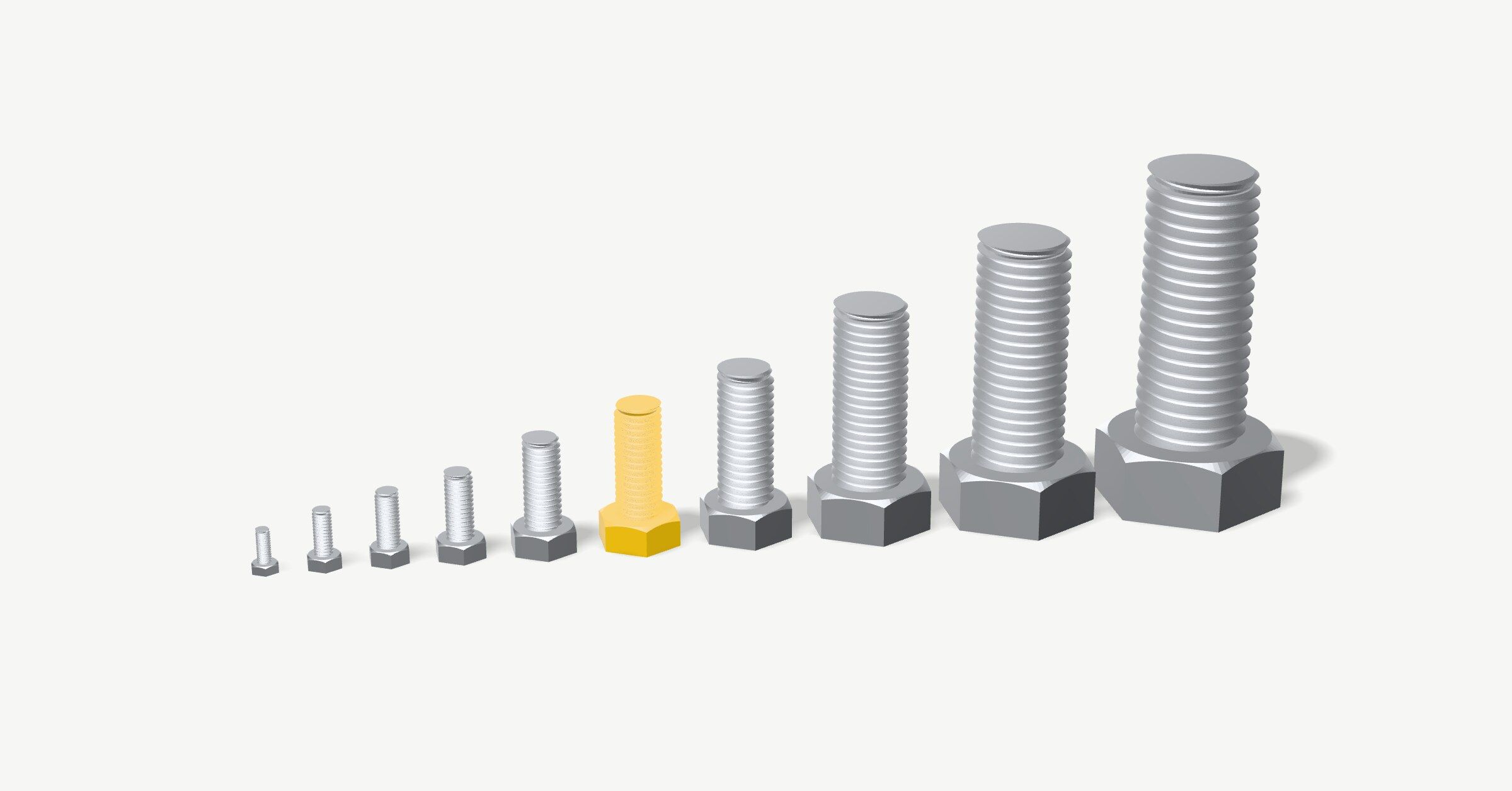
Metric bolt size chart: spanner and hex key sizes, M2 to M24
Tap drill size chart and calculator for every thread
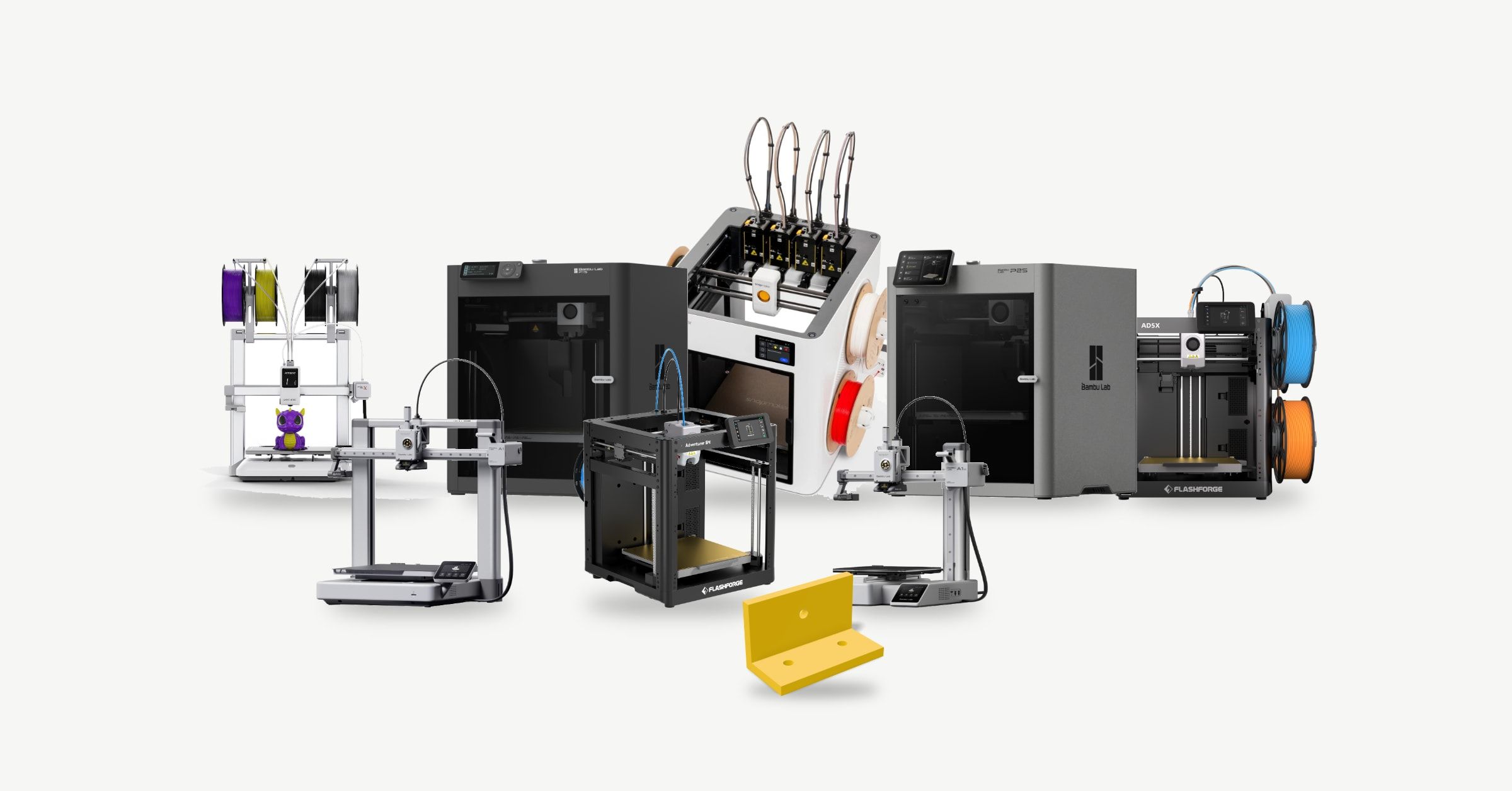
The 8 most popular 3D printers for 2027, tested on the same part


This blog is by the team making CadFlow, where you build your project in 3D and show how it goes together.
See how CadFlow works