3D printer nozzle sizes and materials compared: which nozzle for what
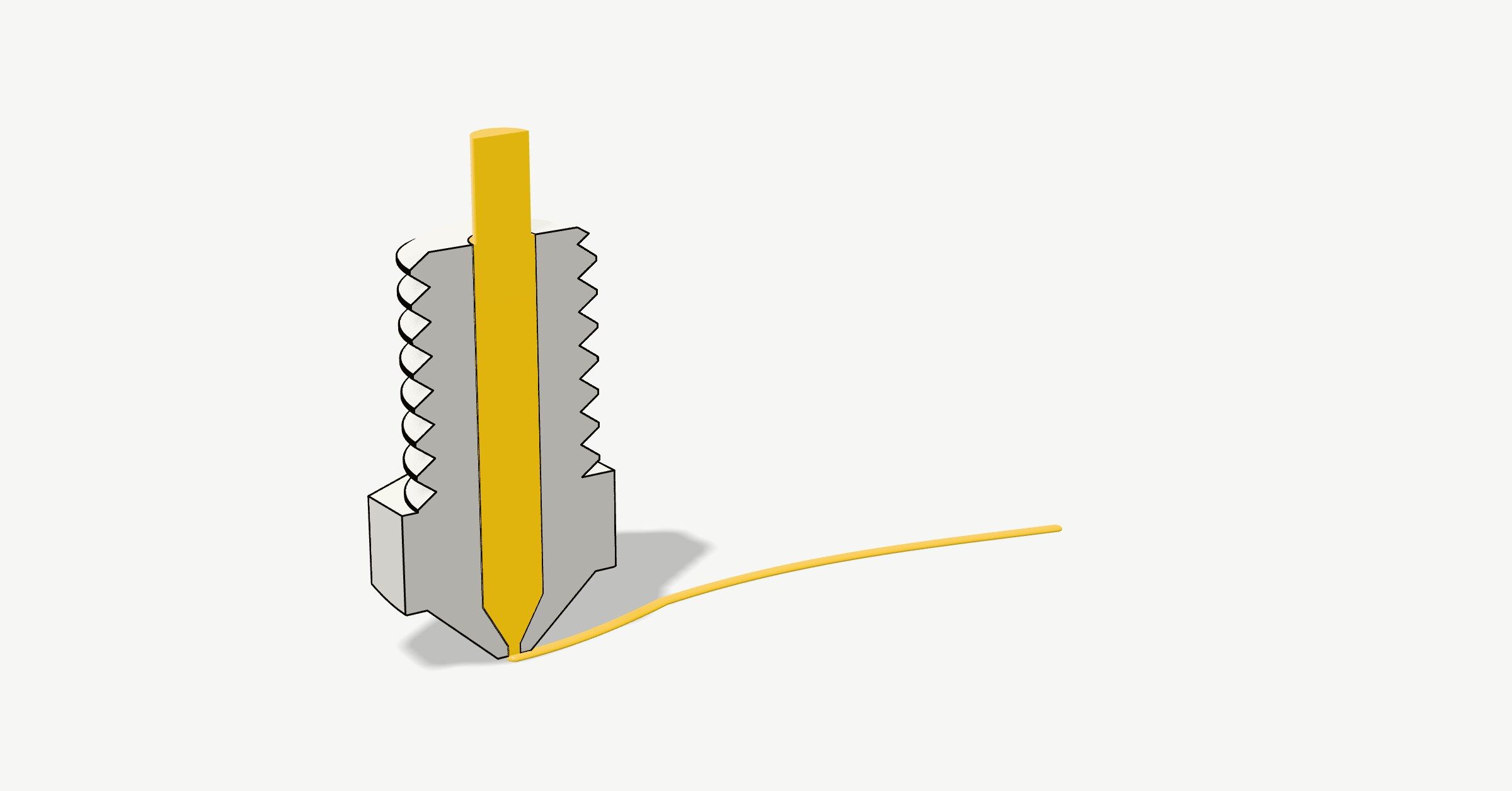
Most printers come with a 0.4 mm nozzle, and for most prints it’s the right one. Changing the size trades detail for speed. Changing the material decides which filaments you can print at all, because carbon fibre and glow-in-the-dark filament grind a brass nozzle down within a spool.
Pick a nozzle size
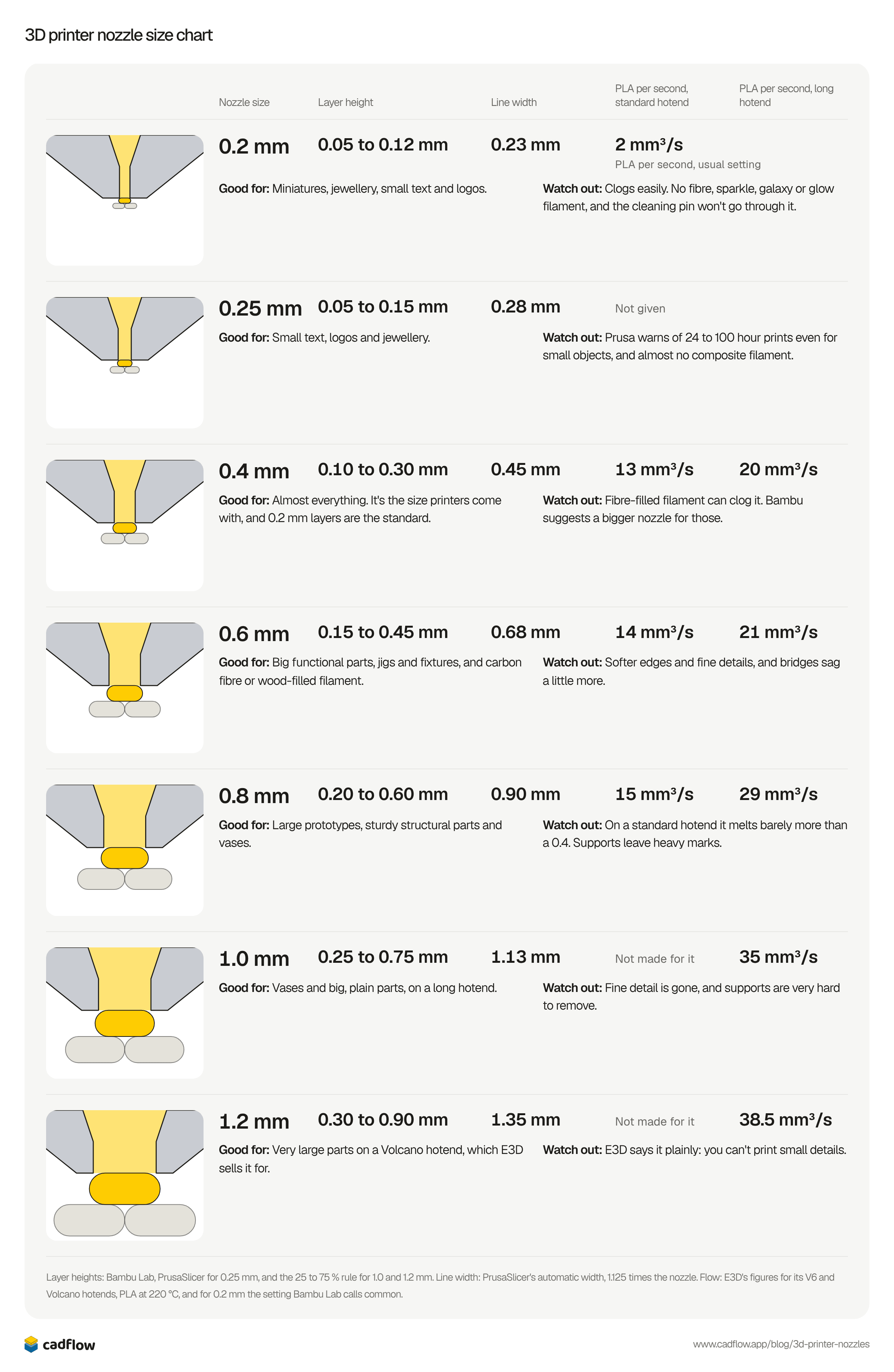
Each size has its own range of layer heights and lays a line a little wider than its hole. The drawings keep one scale for every size, with the line being printed in yellow under the tip, on top of the layer before.
0.2 mm
- Layer height
- 0.05 to 0.12 mm
- Line width
- 0.23 mm
- PLA per second, usual setting
- 2 mm³/sPLA per second, usual setting
Good for: Miniatures, jewellery, small text and logos.
Watch out: Clogs easily. No fibre, sparkle, galaxy or glow filament, and the cleaning pin won't go through it.
0.25 mm
- Layer height
- 0.05 to 0.15 mm
- Line width
- 0.28 mm
- PLA per second
- Not given
Good for: Small text, logos and jewellery.
Watch out: Prusa warns of 24 to 100 hour prints even for small objects, and almost no composite filament.
0.4 mm
- Layer height
- 0.10 to 0.30 mm
- Line width
- 0.45 mm
- PLA per second, standard hotend
- 13 mm³/s
- PLA per second, long hotend
- 20 mm³/s
Good for: Almost everything. It's the size printers come with, and 0.2 mm layers are the standard.
Watch out: Fibre-filled filament can clog it. Bambu suggests a bigger nozzle for those.
0.6 mm
- Layer height
- 0.15 to 0.45 mm
- Line width
- 0.68 mm
- PLA per second, standard hotend
- 14 mm³/s
- PLA per second, long hotend
- 21 mm³/s
Good for: Big functional parts, jigs and fixtures, and carbon fibre or wood-filled filament.
Watch out: Softer edges and fine details, and bridges sag a little more.
0.8 mm
- Layer height
- 0.20 to 0.60 mm
- Line width
- 0.90 mm
- PLA per second, standard hotend
- 15 mm³/s
- PLA per second, long hotend
- 29 mm³/s
Good for: Large prototypes, sturdy structural parts and vases.
Watch out: On a standard hotend it melts barely more than a 0.4. Supports leave heavy marks.
1.0 mm
- Layer height
- 0.25 to 0.75 mm
- Line width
- 1.13 mm
- PLA per second, standard hotend
- Not made for it
- PLA per second, long hotend
- 35 mm³/s
Good for: Vases and big, plain parts, on a long hotend.
Watch out: Fine detail is gone, and supports are very hard to remove.
1.2 mm
- Layer height
- 0.30 to 0.90 mm
- Line width
- 1.35 mm
- PLA per second, standard hotend
- Not made for it
- PLA per second, long hotend
- 38.5 mm³/s
Good for: Very large parts on a Volcano hotend, which E3D sells it for.
Watch out: E3D says it plainly: you can't print small details.
Layer heights: Bambu Lab, PrusaSlicer for 0.25 mm, and the 25 to 75 % rule for 1.0 and 1.2 mm. Line width: PrusaSlicer's automatic width, 1.125 times the nozzle. Flow: E3D's figures for its V6 and Volcano hotends, PLA at 220 °C, and for 0.2 mm the setting Bambu Lab calls common.
A bigger nozzle isn’t always faster
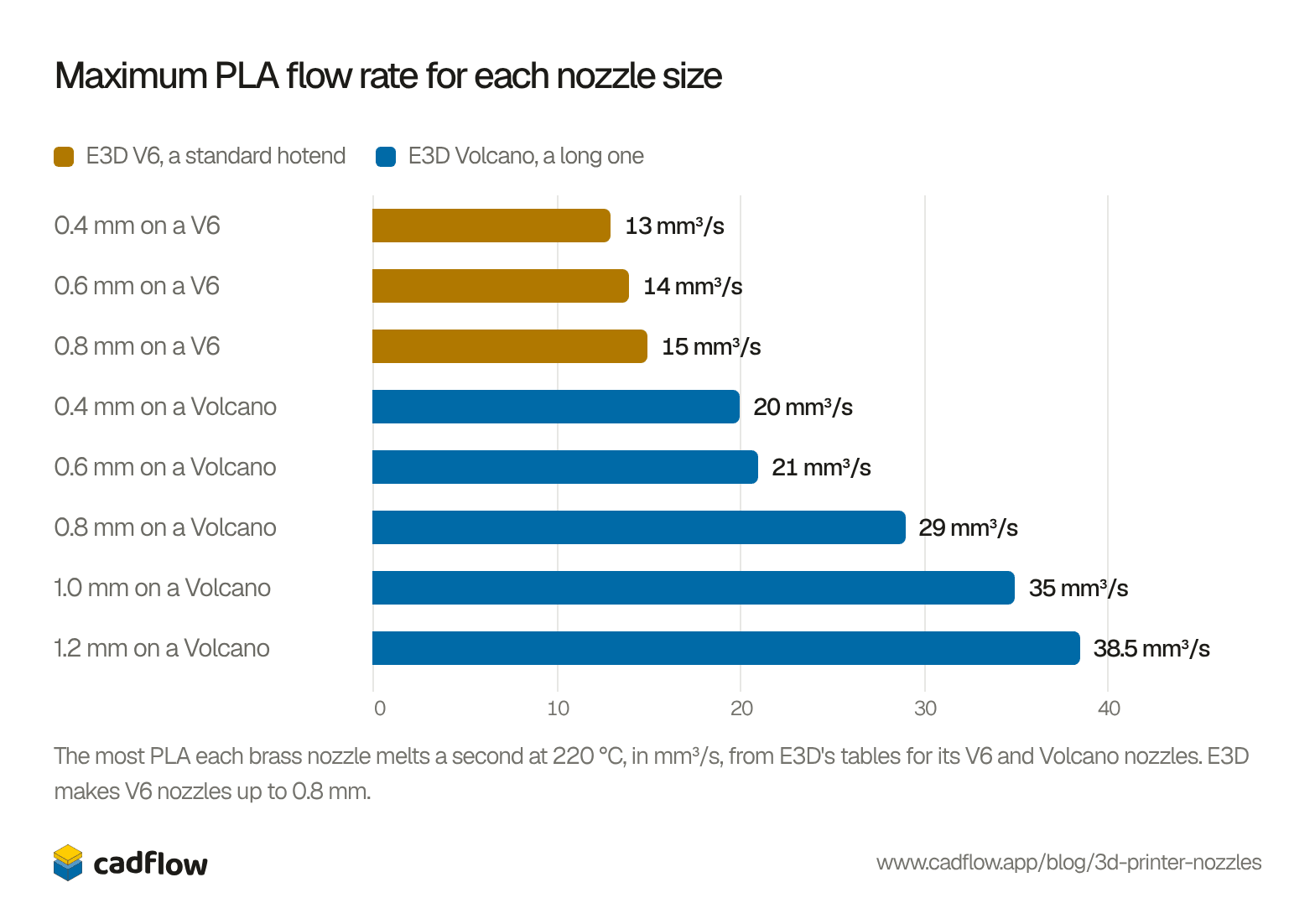
A bigger hole lets you print thicker lines, but the plastic still has to melt on its way through, and it melts in the hotend, not in the hole. You can see it in E3D’s own figures. On its standard V6 hotend, a 0.8 mm nozzle melts 15 mm³ of PLA a second, only 2 more than a 0.4. On the Volcano, whose heater block and nozzle are longer, the same 0.8 mm nozzle melts 29.
E3D V6, a standard hotendE3D Volcano, a long one
Show as a table
| Nozzle | PLA per second |
|---|---|
| 0.4 mm on a V6 | 13 mm³/s |
| 0.6 mm on a V6 | 14 mm³/s |
| 0.8 mm on a V6 | 15 mm³/s |
| 0.4 mm on a Volcano | 20 mm³/s |
| 0.6 mm on a Volcano | 21 mm³/s |
| 0.8 mm on a Volcano | 29 mm³/s |
| 1.0 mm on a Volcano | 35 mm³/s |
| 1.2 mm on a Volcano | 38.5 mm³/s |
CNC Kitchen measured the same thing with 0.6 mm nozzles, counting how much plastic each could push before it fell 5 % short. The V6 managed 15 mm³/s, the Volcano 30, and Bondtech’s CHT nozzle 40, because it splits the plastic into channels inside the nozzle so more of it touches hot metal.
So before you buy a 0.8 or 1.0 mm nozzle for speed, check how much your hotend can melt. When a user on Bambu Lab’s forum found a print in PETG-CF slicing to 4 hours 16 minutes with a 0.8 mm nozzle and 3 hours 47 with a 0.6, Bambu’s support answered that a larger nozzle isn’t necessarily faster, because the filament’s flow sets the limit. The 0.6 is the safer step up. Prusa found it prints up to twice as fast as a 0.4 with almost the same look, and calls it the first extra nozzle to buy.
A bigger nozzle doesn’t make stronger plastic
Bambu Lab’s guide says bigger nozzles make stronger parts. CNC Kitchen tested that on a Prusa MK3S with hooks printed through a 0.4 and a 0.8 mm nozzle, and found the strength followed the amount of plastic. With walls of the same thickness, all five versions held between 347 and 380 N, so the bigger nozzle didn’t bond its layers any better.
The bigger nozzle still wins on time. At twice the width and twice the layer height, a 0.8 mm nozzle lays four times as much plastic in the same time, so for the same print time you get a much heavier, stronger part. If you need strength, add walls, and use the bigger nozzle to print them faster.
Nozzle materials
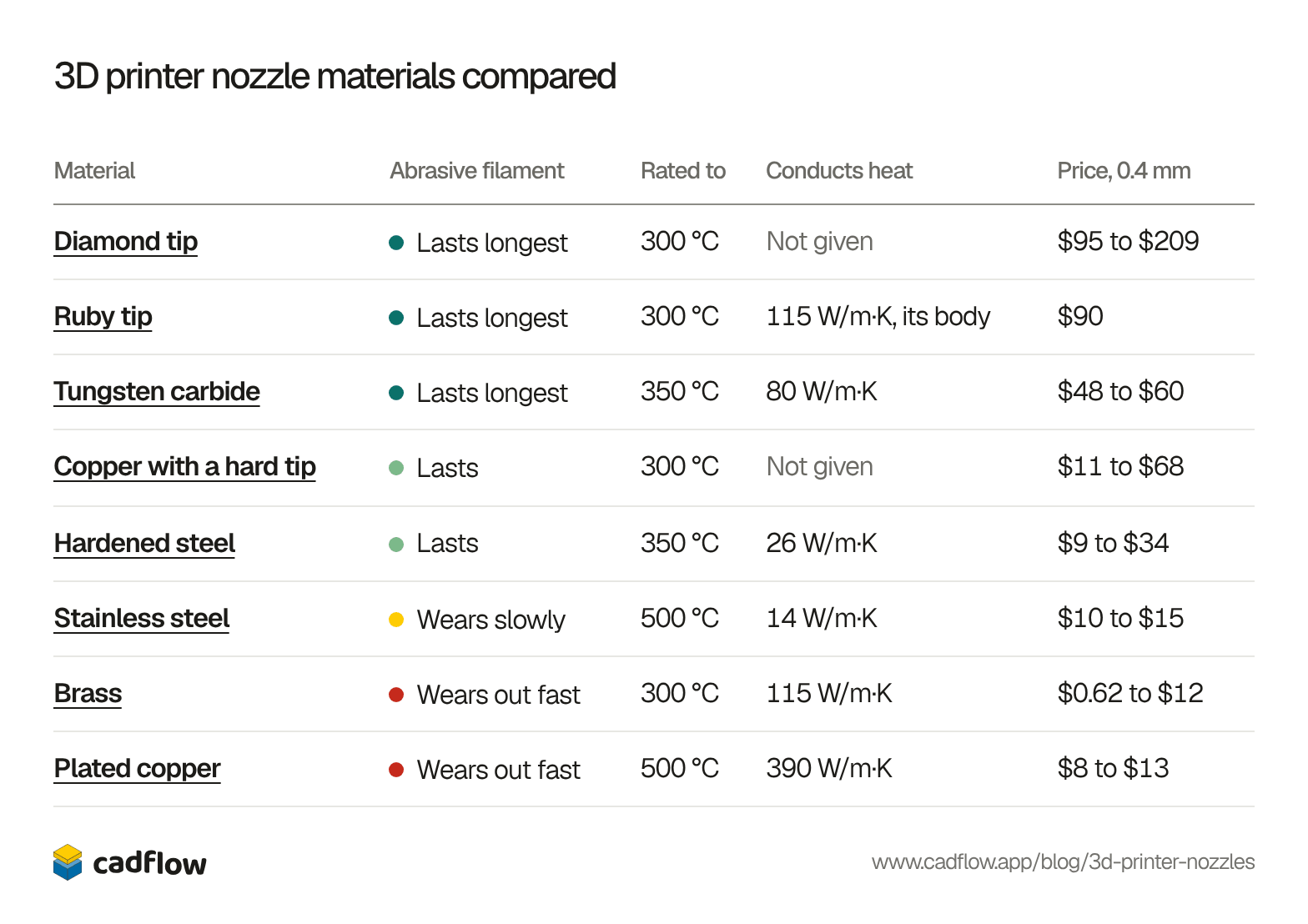
The material decides which filaments a nozzle can take and how hot it can go. Brass is the default because it carries heat well, and every harder material either conducts heat worse or costs far more. That’s why the nozzles that are both hard and quick to heat put a hard tip on a brass or copper body. Sort the table by what matters to you.
| Material | Abrasive filament | Rated to | Conducts heat | Price, 0.4 mm |
|---|---|---|---|---|
| Diamond tip | Lasts longest | 300 °C | Not given | $95 to $209 |
| Ruby tip | Lasts longest | 300 °C | 115 W/m·K, its body | $90 |
| Tungsten carbide | Lasts longest | 350 °C | 80 W/m·K | $48 to $60 |
| Copper with a hard tip | Lasts | 300 °C | Not given | $11 to $68 |
| Hardened steel | Lasts | 350 °C | 26 W/m·K | $9 to $34 |
| Stainless steel | Wears slowly | 500 °C | 14 W/m·K | $10 to $15 |
| Brass | Wears out fast | 300 °C | 115 W/m·K | $0.62 to $12 |
| Plated copper | Wears out fast | 500 °C | 390 W/m·K | $8 to $13 |
| Material | Abrasive filament | Rated to | Conducts heat | Price, 0.4 mm |
|---|---|---|---|---|
| Brass | Wears out fast | 300 °C | 115 W/m·K | $0.62 to $12 |
| Plated copper | Wears out fast | 500 °C | 390 W/m·K | $8 to $13 |
| Hardened steel | Lasts | 350 °C | 26 W/m·K | $9 to $34 |
| Stainless steel | Wears slowly | 500 °C | 14 W/m·K | $10 to $15 |
| Copper with a hard tip | Lasts | 300 °C | Not given | $11 to $68 |
| Tungsten carbide | Lasts longest | 350 °C | 80 W/m·K | $48 to $60 |
| Ruby tip | Lasts longest | 300 °C | 115 W/m·K, its body | $90 |
| Diamond tip | Lasts longest | 300 °C | Not given | $95 to $209 |
| Material | Abrasive filament | Rated to | Conducts heat | Price, 0.4 mm |
|---|---|---|---|---|
| Stainless steel | Wears slowly | 500 °C | 14 W/m·K | $10 to $15 |
| Plated copper | Wears out fast | 500 °C | 390 W/m·K | $8 to $13 |
| Tungsten carbide | Lasts longest | 350 °C | 80 W/m·K | $48 to $60 |
| Hardened steel | Lasts | 350 °C | 26 W/m·K | $9 to $34 |
| Diamond tip | Lasts longest | 300 °C | Not given | $95 to $209 |
| Ruby tip | Lasts longest | 300 °C | 115 W/m·K, its body | $90 |
| Copper with a hard tip | Lasts | 300 °C | Not given | $11 to $68 |
| Brass | Wears out fast | 300 °C | 115 W/m·K | $0.62 to $12 |
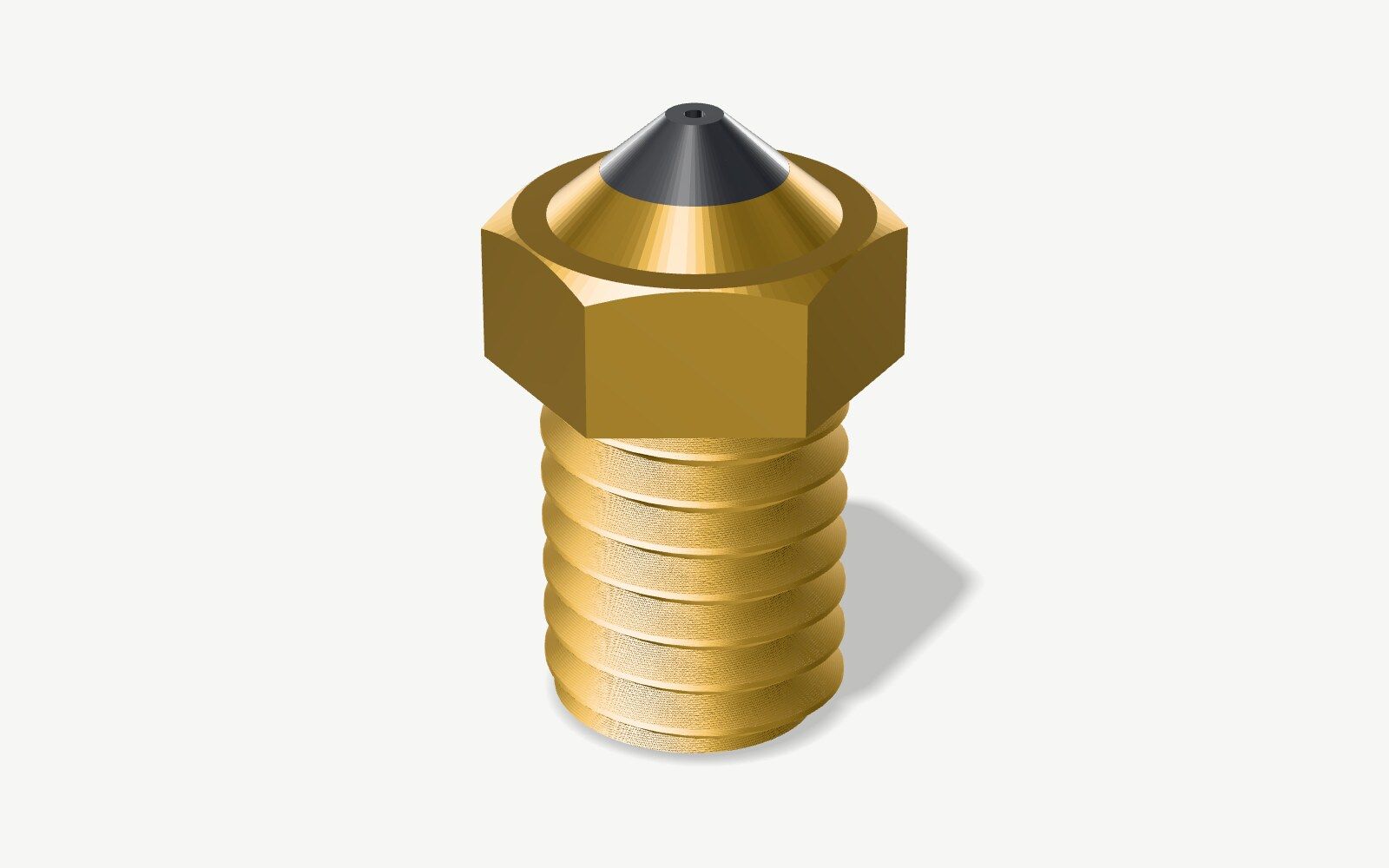
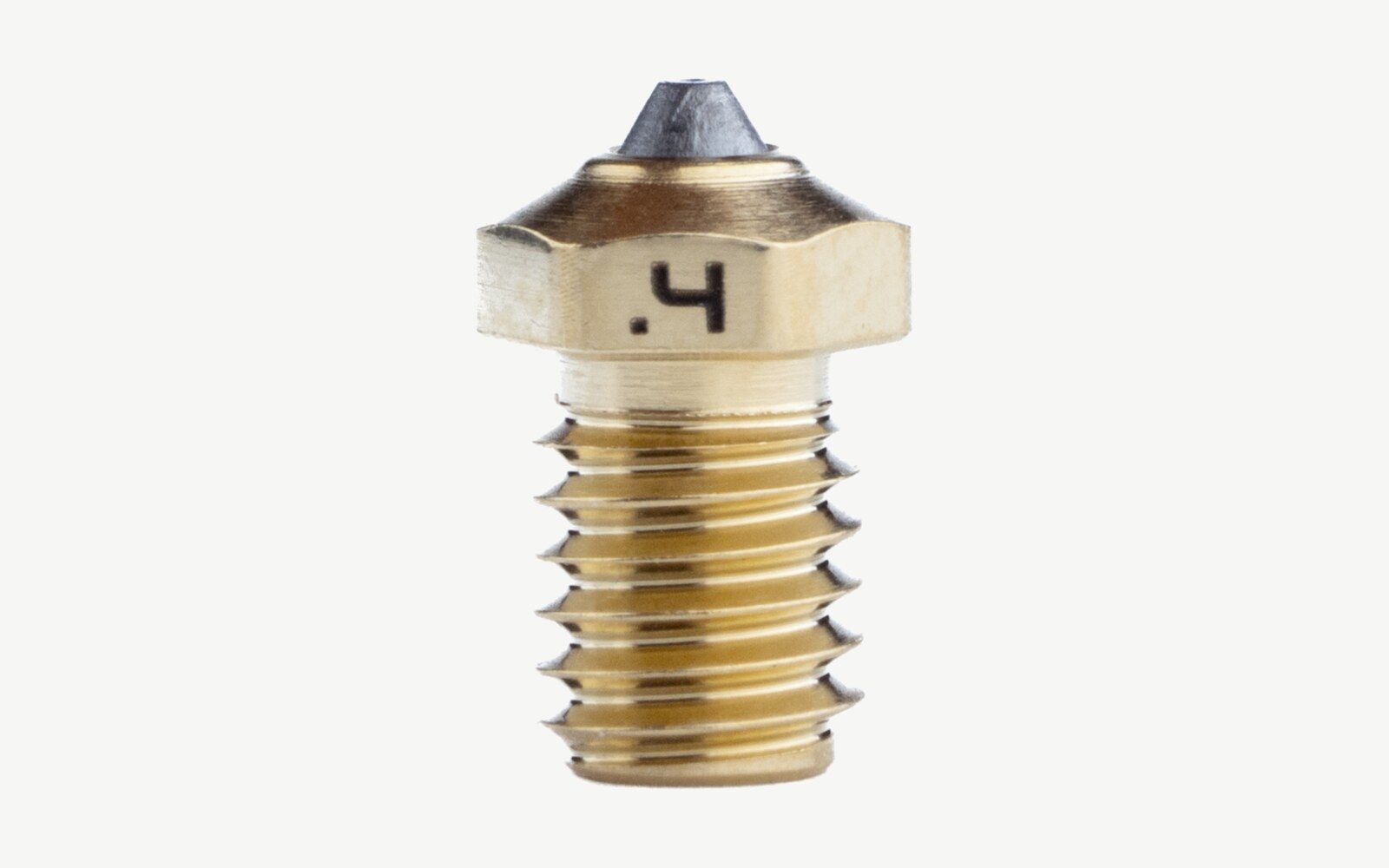
Diamond tip
Polycrystalline diamond set into the tip of a metal body
$95 to $209 for a 0.4 mm nozzle
Good for: Any abrasive filament, every day
Pros
- The hardest material a nozzle is made of
- Made for almost every printer
Cons
- $95 to $209 for one nozzle
- No independent wear test yet
Data: E3D · Picture: our own model, rendered
Data: E3D
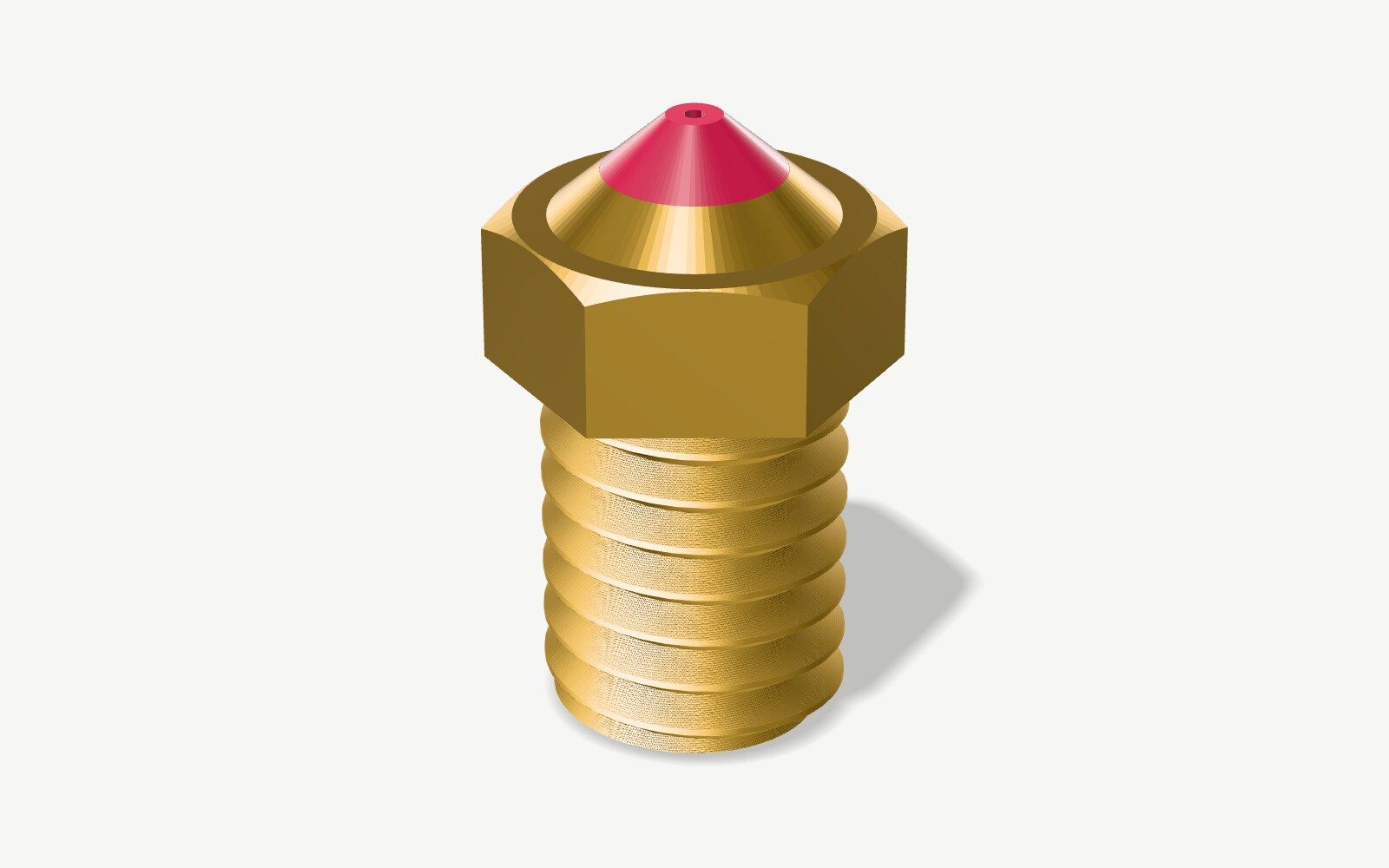
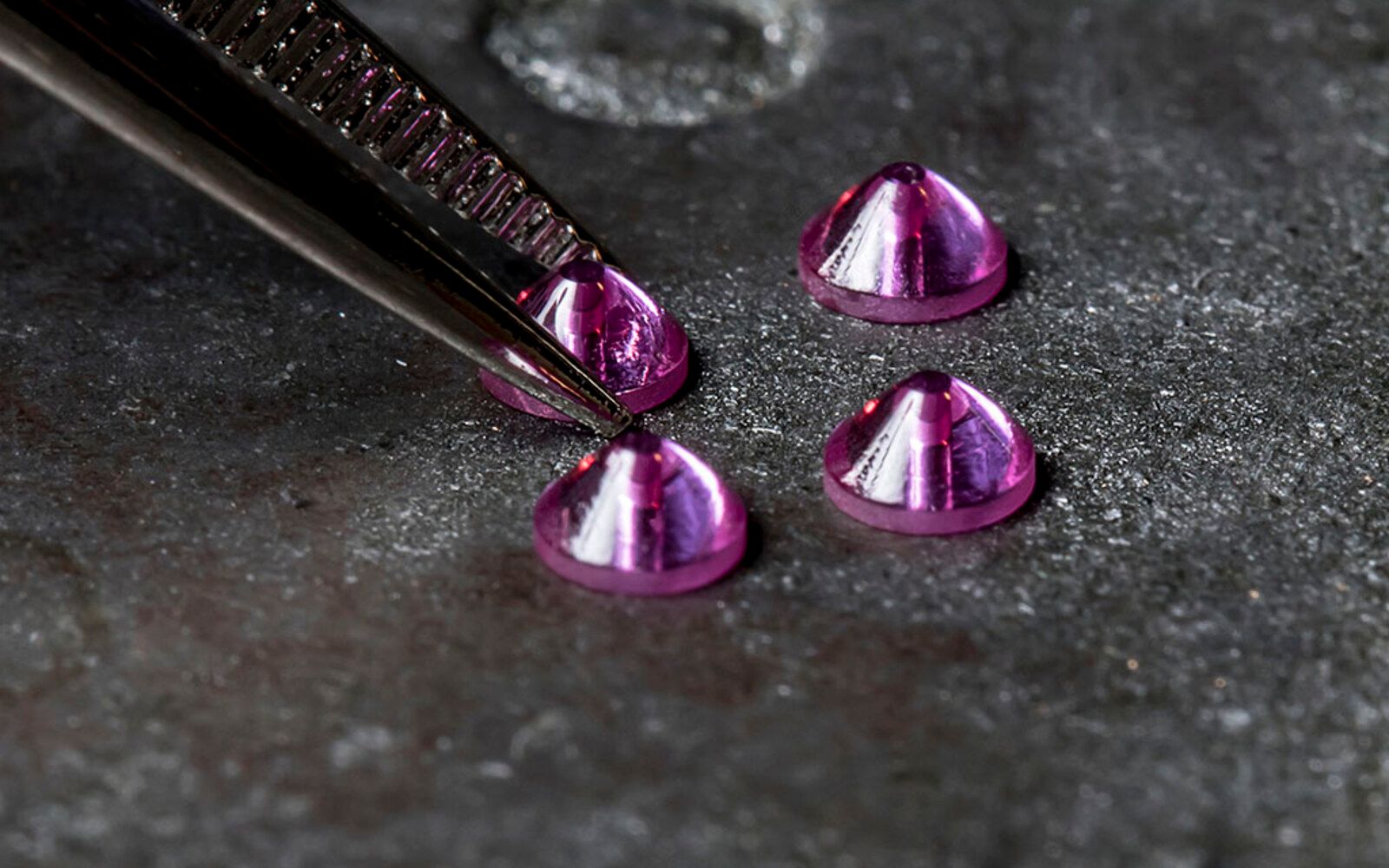
Ruby tip
A brass body with a ruby set into the tip
$90 for a 0.4 mm nozzle
Good for: Any abrasive filament, every day
Pros
- No visible wear after 8 kg of carbon fibre in Olsson's test
- The brass body carries heat like any brass nozzle
- 500 °C in the High Temp version
Cons
- The ruby can crack if the nozzle hits the bed
- From $90, and out of stock at MatterHackers when we looked
Data: Olsson · Picture: our own model, rendered
Data: Olsson
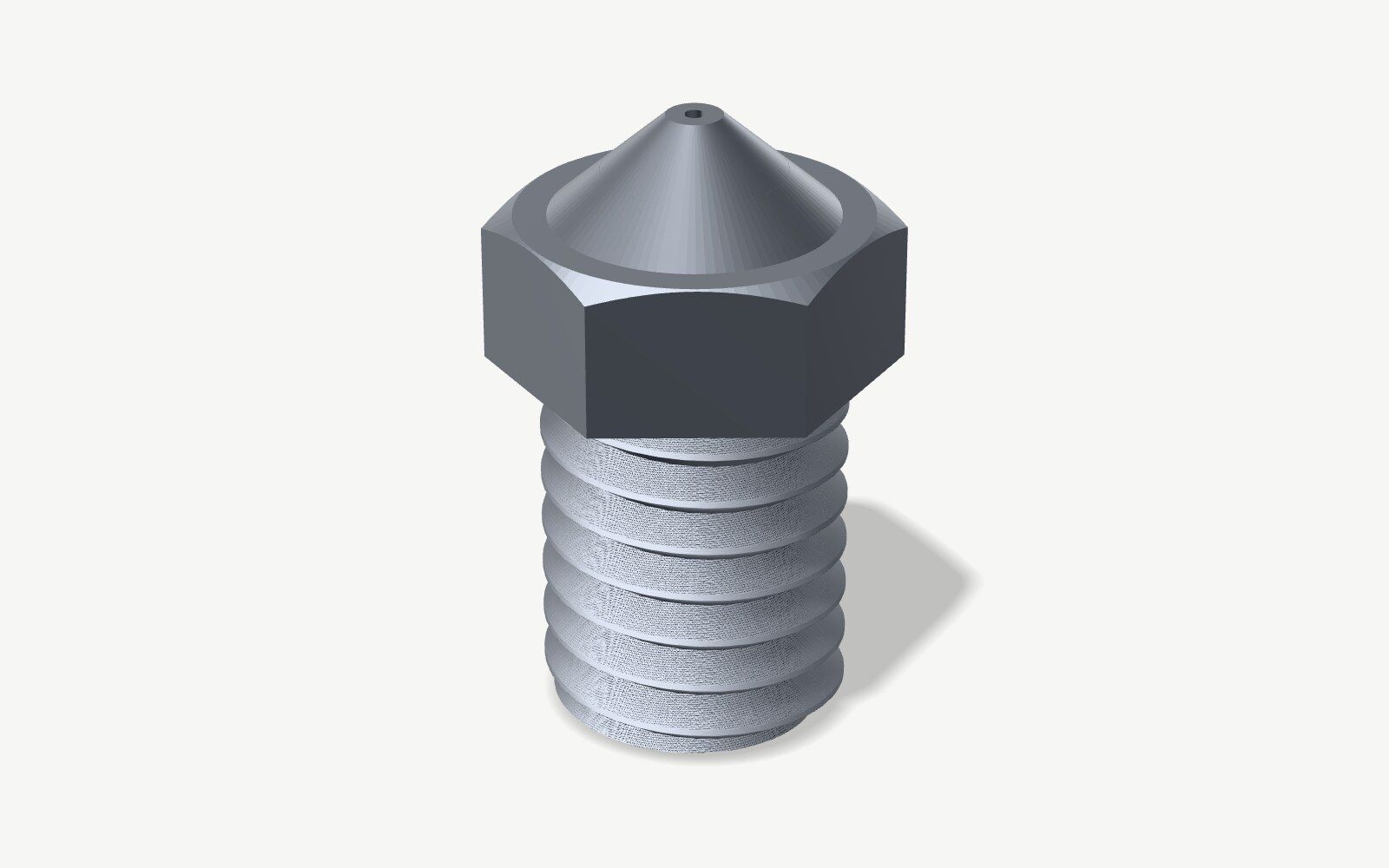
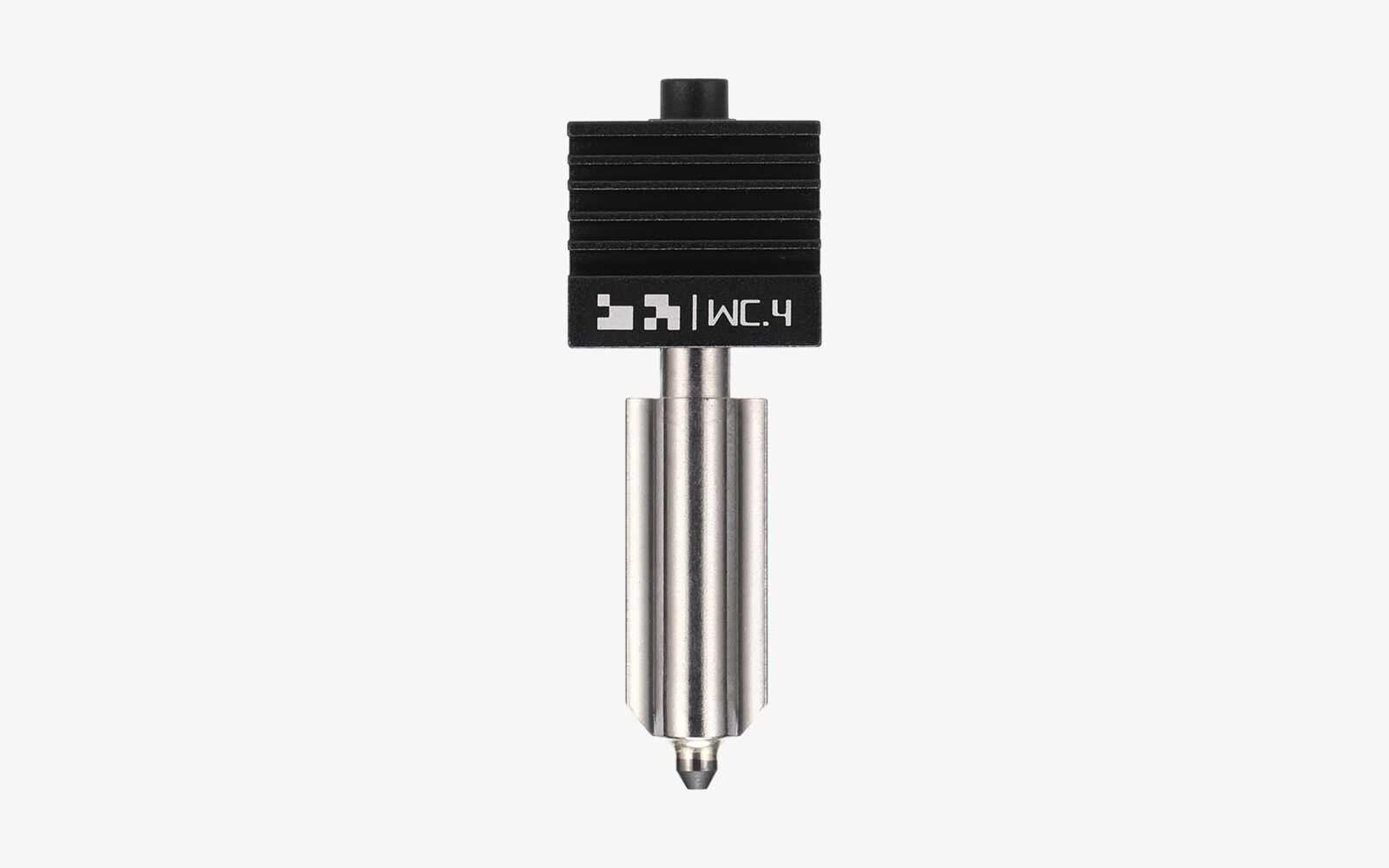
Tungsten carbide
Tungsten carbide grains held together with cobalt
$48 to $60 for a 0.4 mm nozzle
Good for: Carbon and glass fibre filament on Bambu Lab's H2 and P2S printers
Pros
- HRA 90, against 74 for Bambu's hardened steel
- Conducts heat three times as well as hardened steel
Cons
- $48 to $60 for one nozzle
- Bambu's claim of 50 % more life has no published test
- Only for Bambu Lab's H2D, H2S, P2S and X2D
Data: Bambu Lab · Picture: our own model, rendered
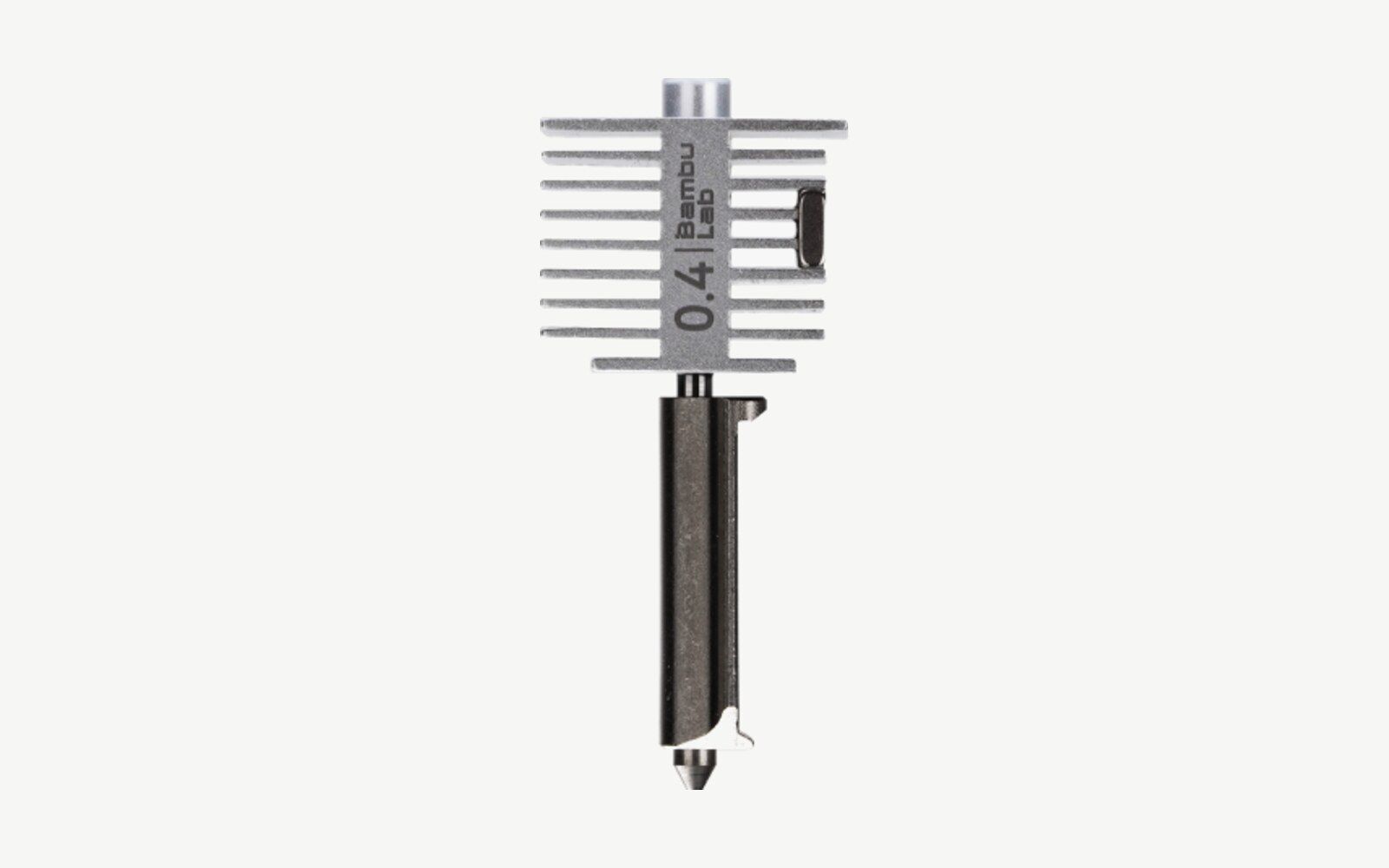
Data: Bambu Lab · Photo: Bambu Lab
Data: Bambu Lab
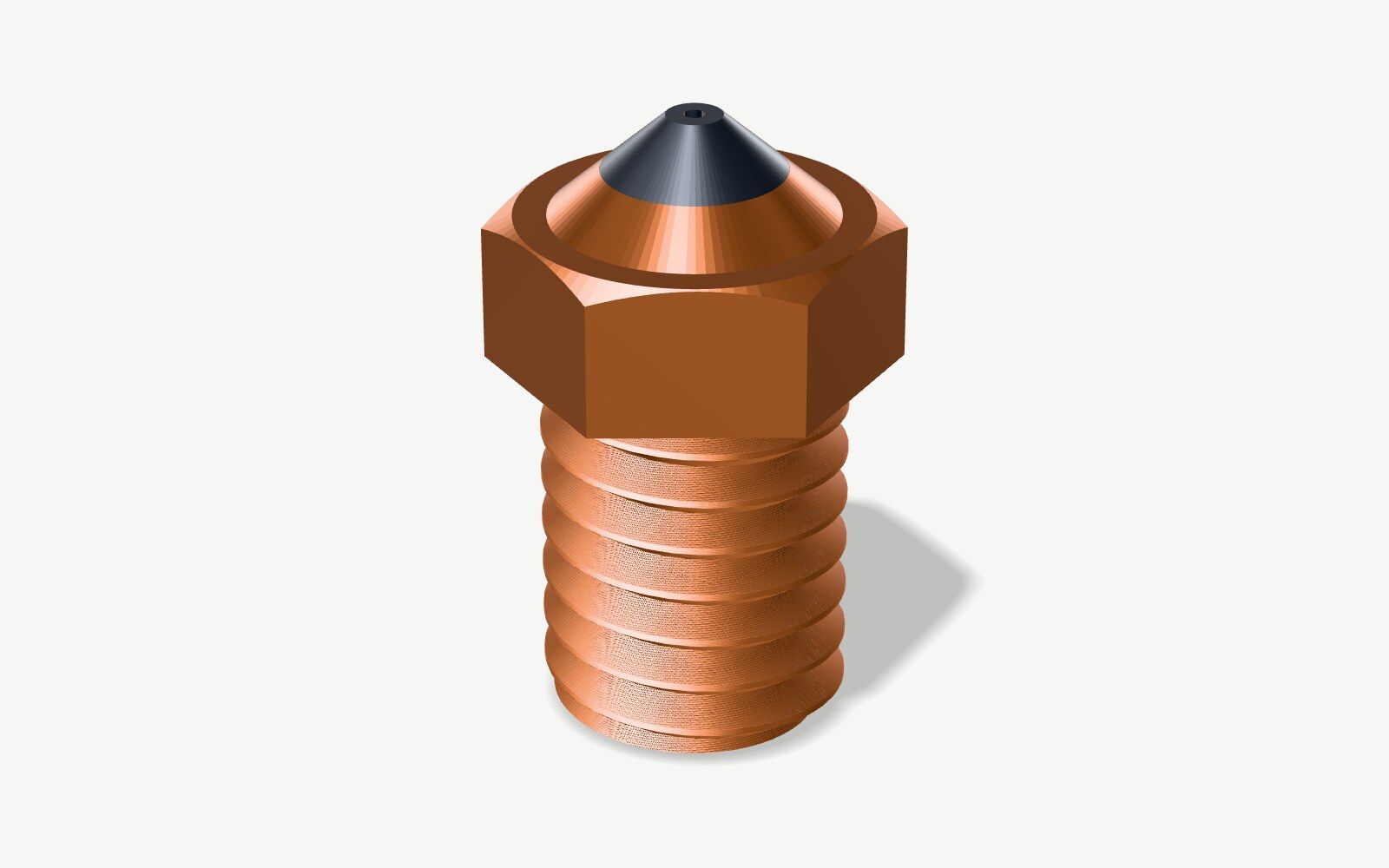
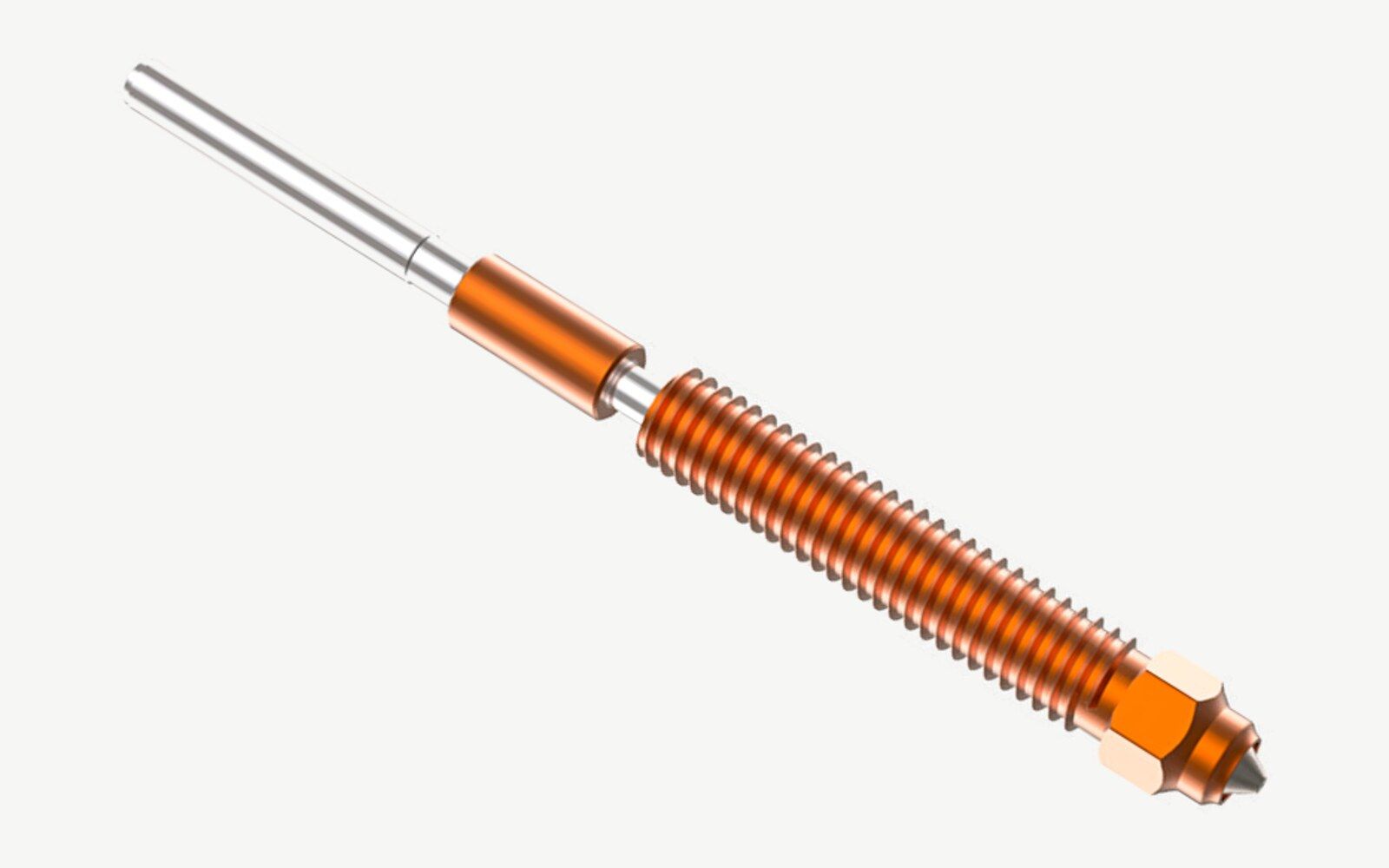
Copper with a hard tip
A copper alloy body with a hardened steel insert where the plastic leaves
$11 to $68 for a 0.4 mm nozzle
Good for: Abrasive and plain filament alike, at brass temperatures
Pros
- Heats the plastic about as well as brass
- Hardened steel where the plastic rubs
- 500 °C in E3D's ObXidian 500
Cons
- Up to ten times the price of brass
- E3D warns some fibre filaments wear even ObXidian
Data: E3D · Picture: our own model, rendered
Data: E3D
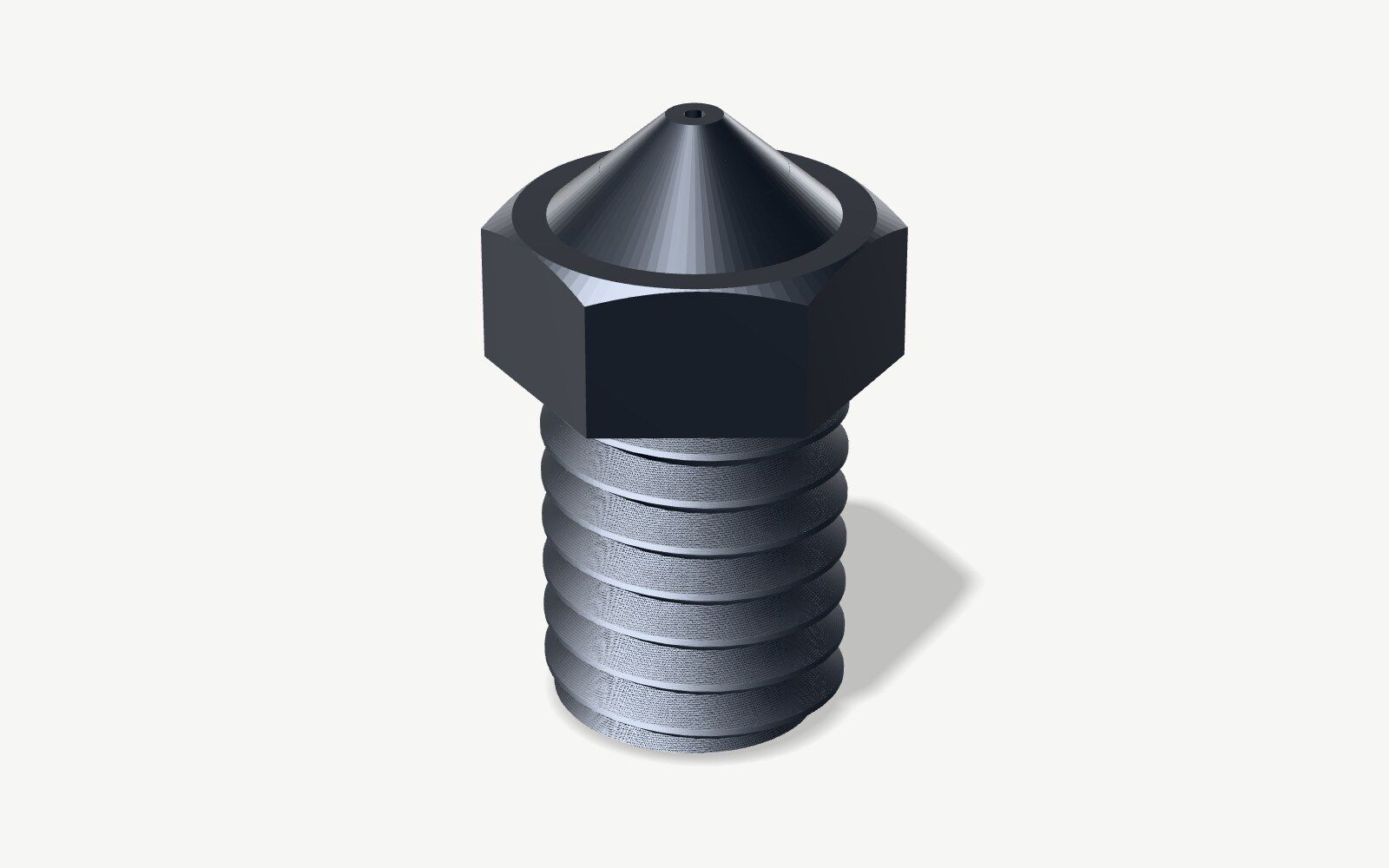
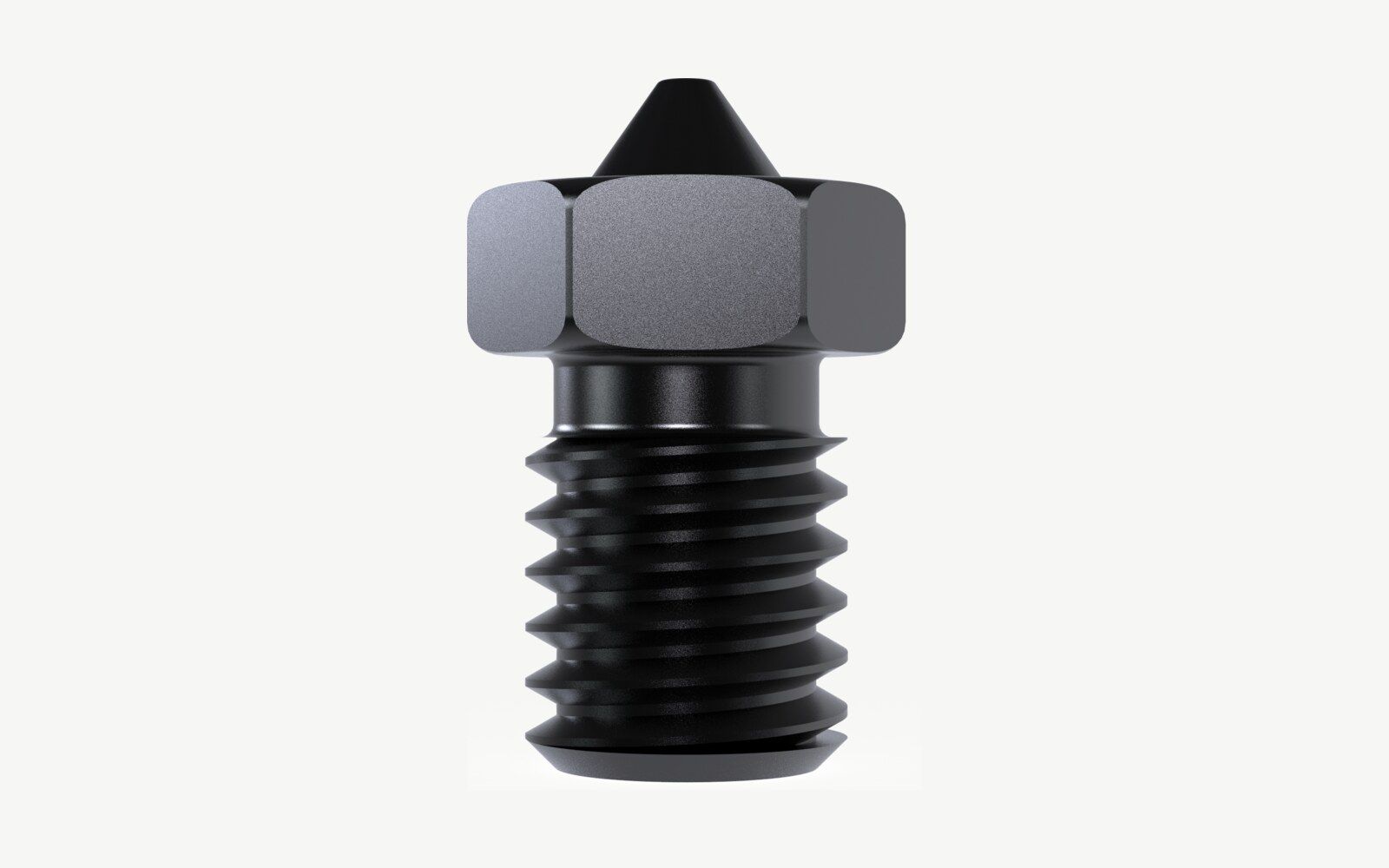
Hardened steel
Tool steel, heat treated to about 62 to 65 HRC
$9 to $34 for a 0.4 mm nozzle
Good for: Carbon and glass fibre, glow-in-the-dark and other abrasive filament
Pros
- Lasts through kilograms of fibre-filled filament
- Cheap enough to keep a spare
Cons
- Needs 5 to 10 °C more than brass
- Softens above 350 °C, but plated ones like E3D's Nozzle X take 500 °C
Data: E3D · Picture: our own model, rendered
Data: E3D
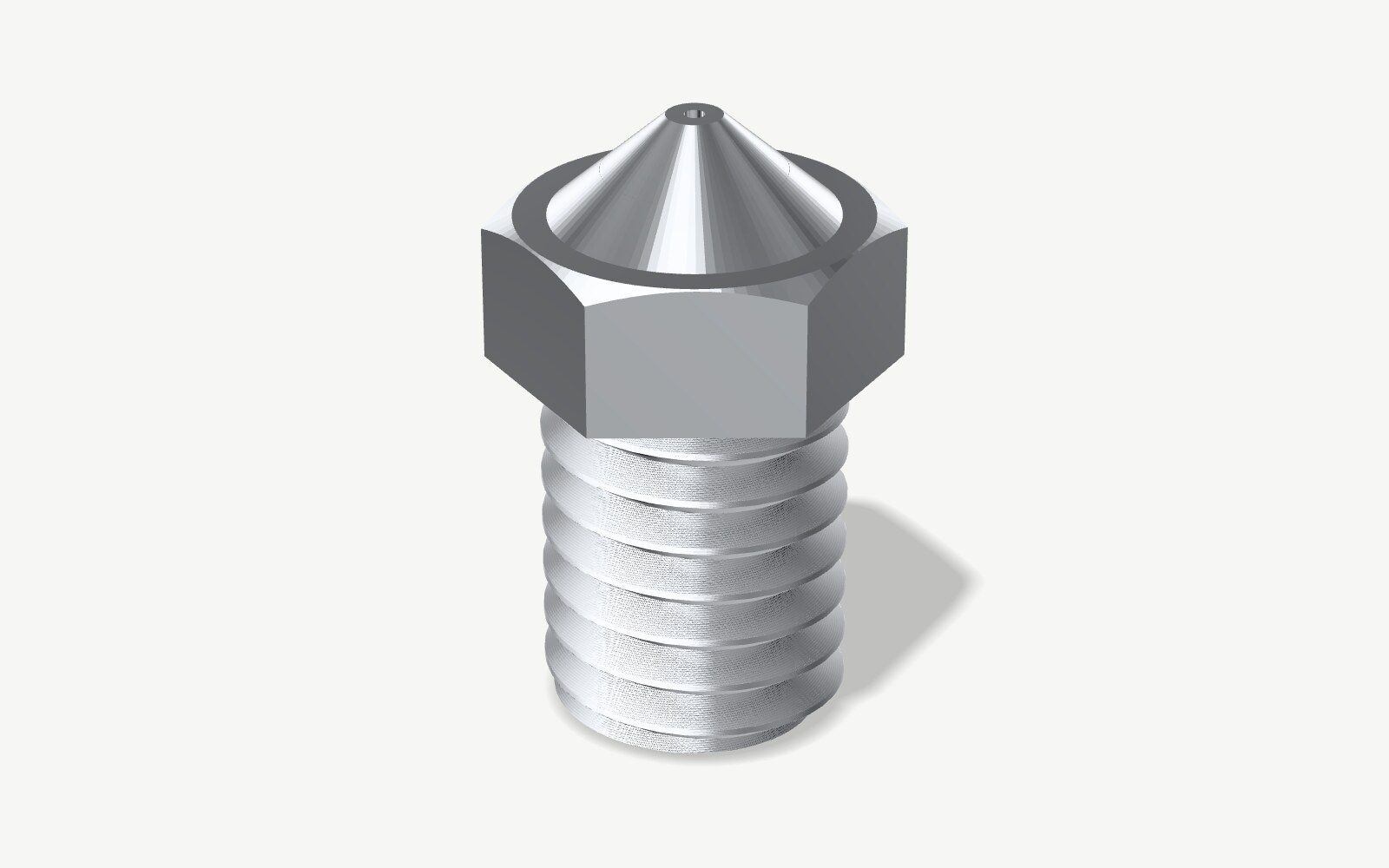
Stainless steel
Steel with chromium in it, so it doesn't rust
$10 to $15 for a 0.4 mm nozzle
Good for: Plain filament, and parts that touch food
Pros
- No lead, so it suits parts that touch food
- Rated to 500 °C
Cons
- Conducts heat worst of all, an eighth as well as brass
- Wears at about 30 % of brass's rate, E3D says
- Opened up after 10 hours of PETG-CF, Bambu Lab found
Data: E3D · Picture: our own model, rendered
Data: E3D
Brass
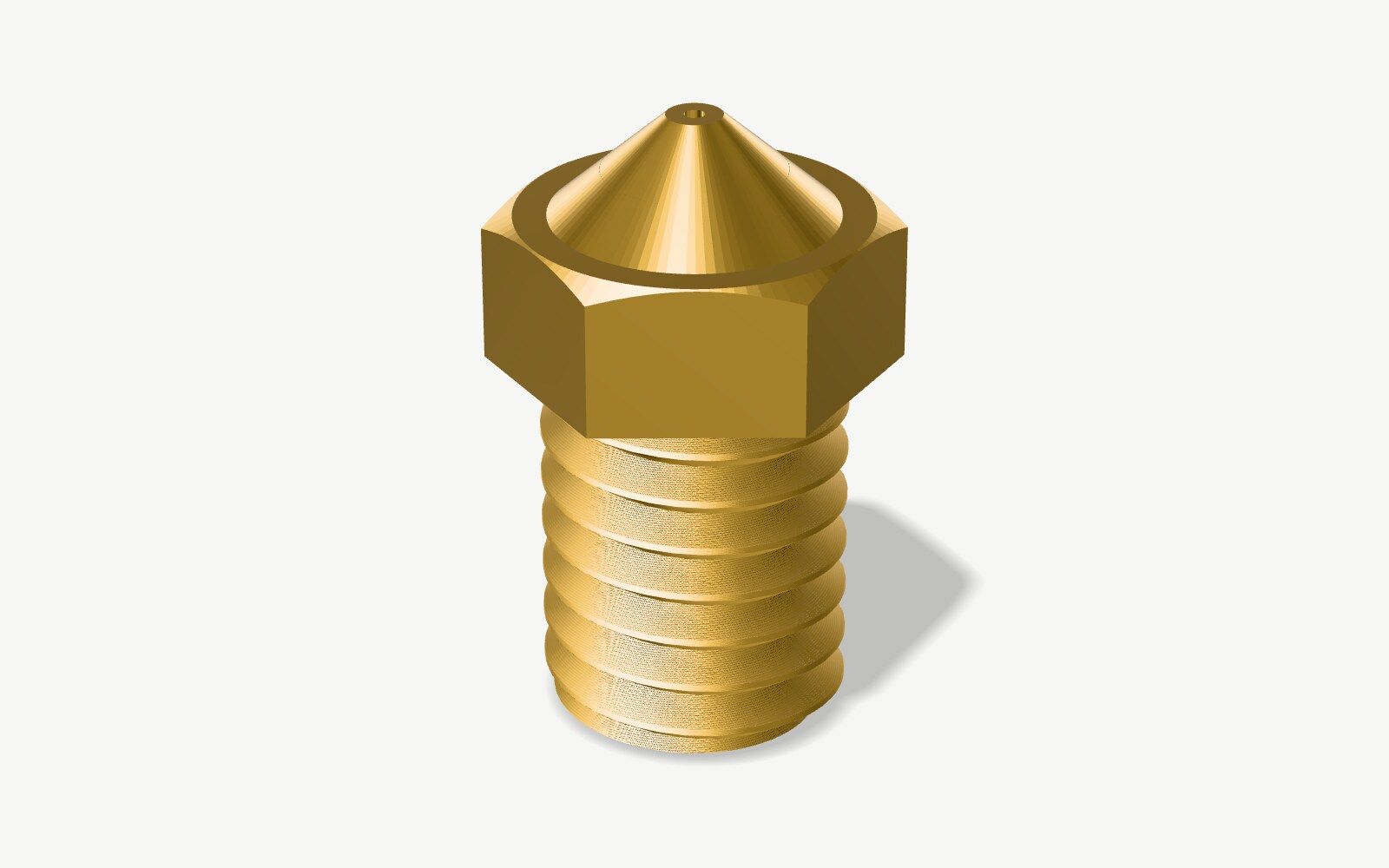
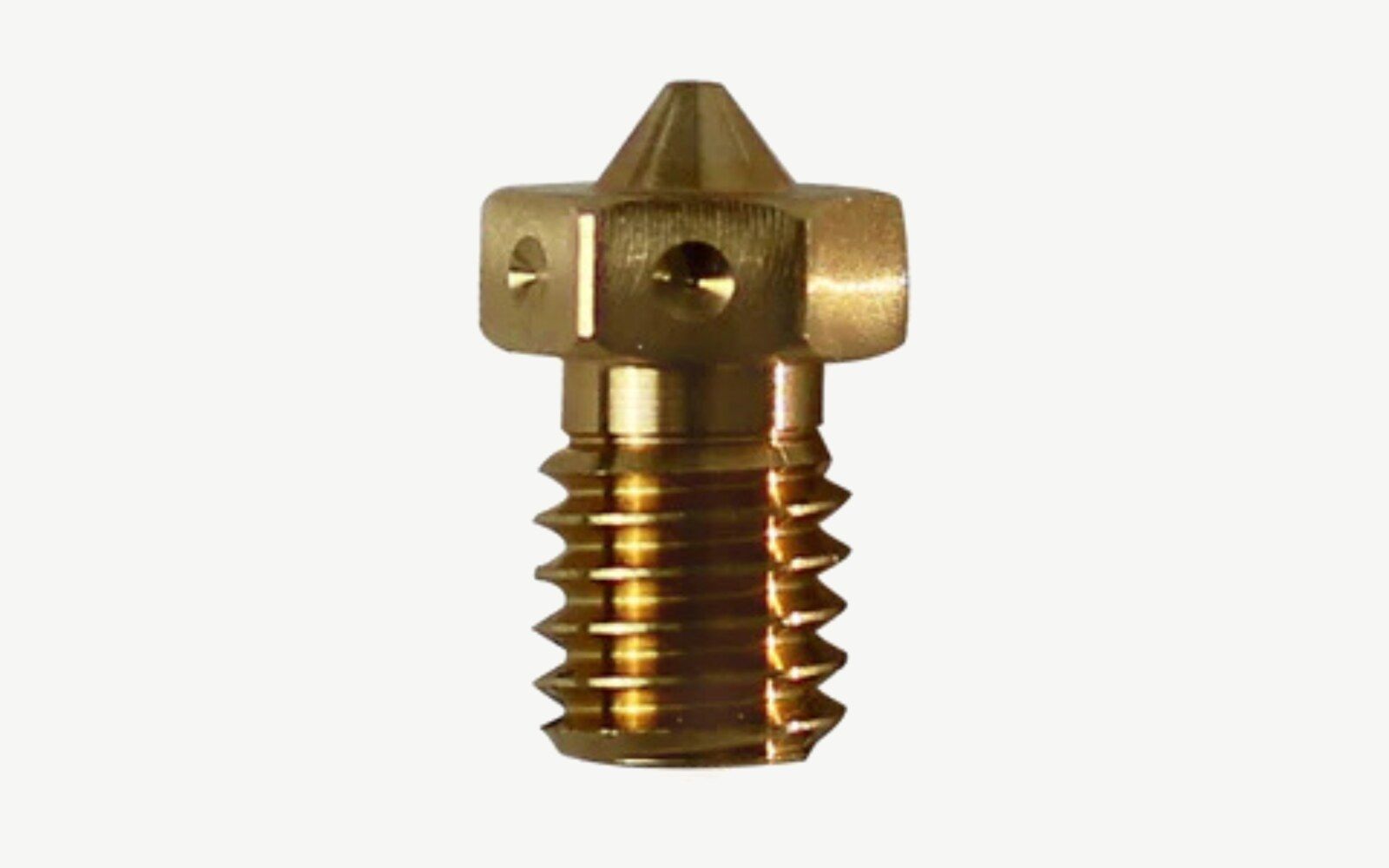
Copper and zinc, usually with a little lead
$0.62 to $12 for a 0.4 mm nozzle
Good for: PLA, PETG, ABS, ASA and TPU
Pros
- What printers come with, and what slicer profiles assume
- Conducts heat four times as well as hardened steel
- 24 for $14.99 from Creality, or $5 to $12 for a branded one
Cons
- Abrasive filament wears it out within a spool
- Rated to 300 °C, and most brass has a little lead in it
Data: E3D · Picture: our own model, rendered
Data: E3D
Plated copper
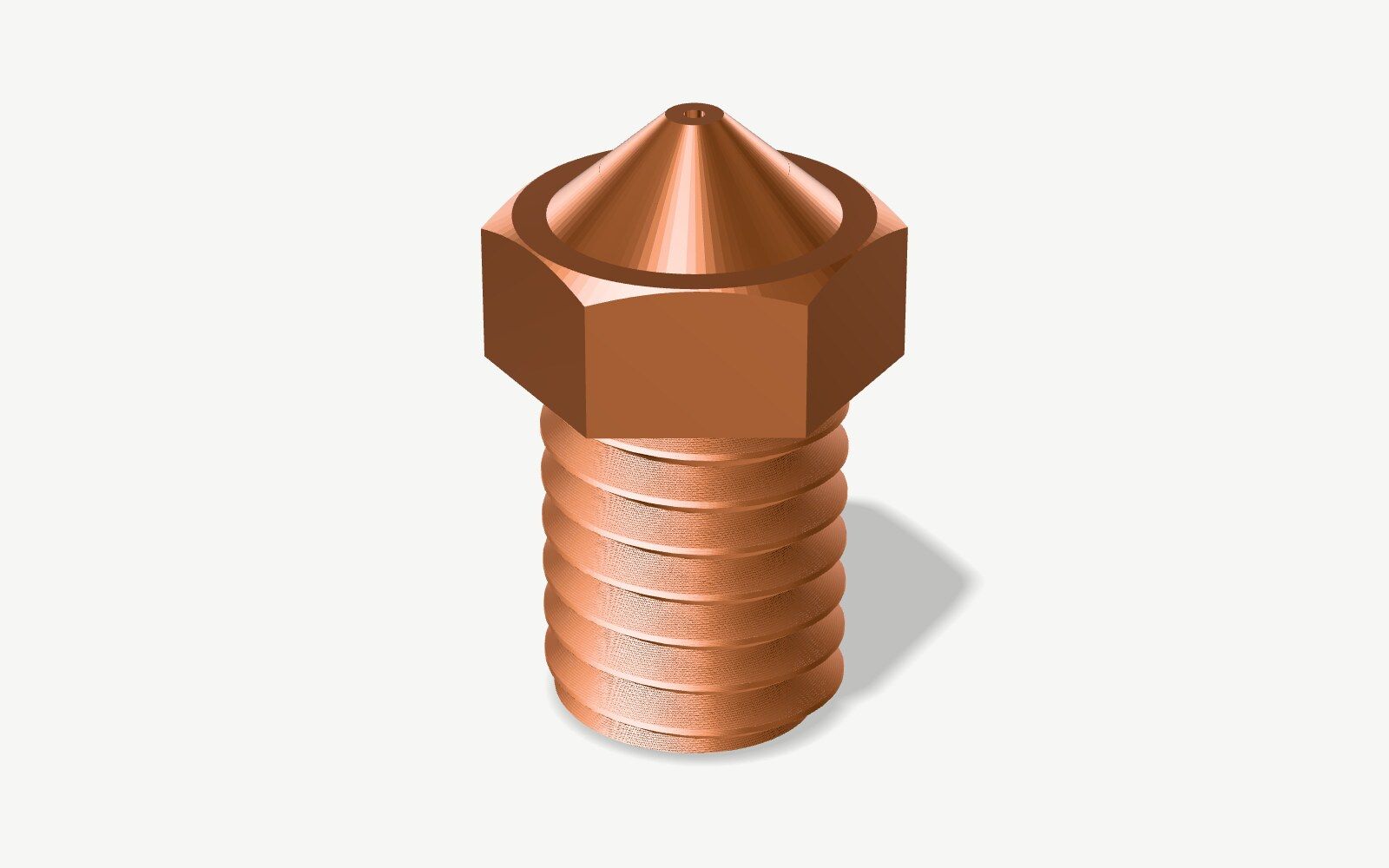
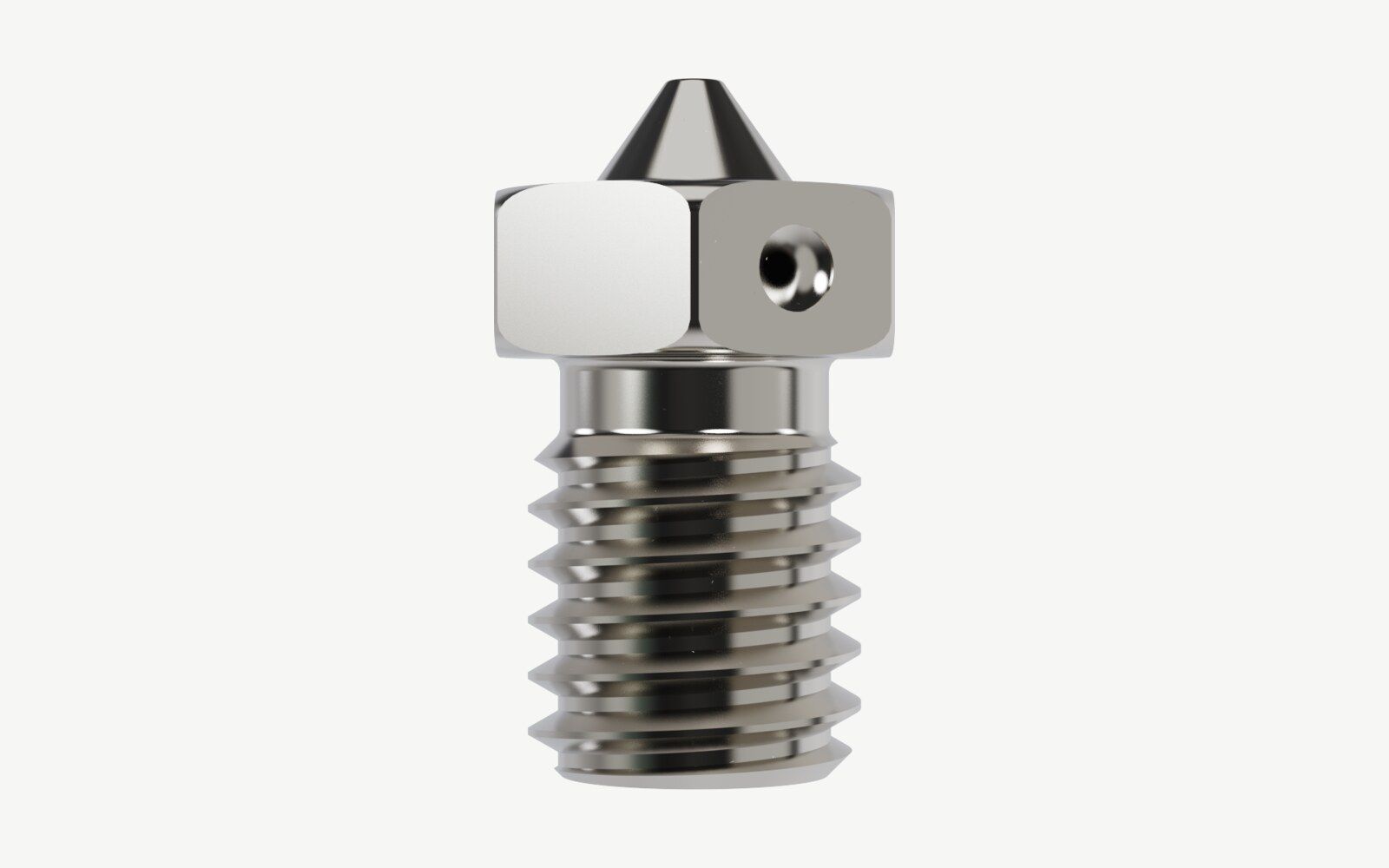
Copper with a thin nickel plating
$8 to $13 for a 0.4 mm nozzle
Good for: Plain filament printed above 300 °C, such as PEI
Pros
- Conducts heat best of all the metals here
- Rated to 500 °C
Cons
- Not for any abrasive filament
- Softer than brass, so it dents and scratches more easily
Data: E3D · Picture: our own model, rendered
Data: E3D
Why hardened steel needs a hotter nozzle
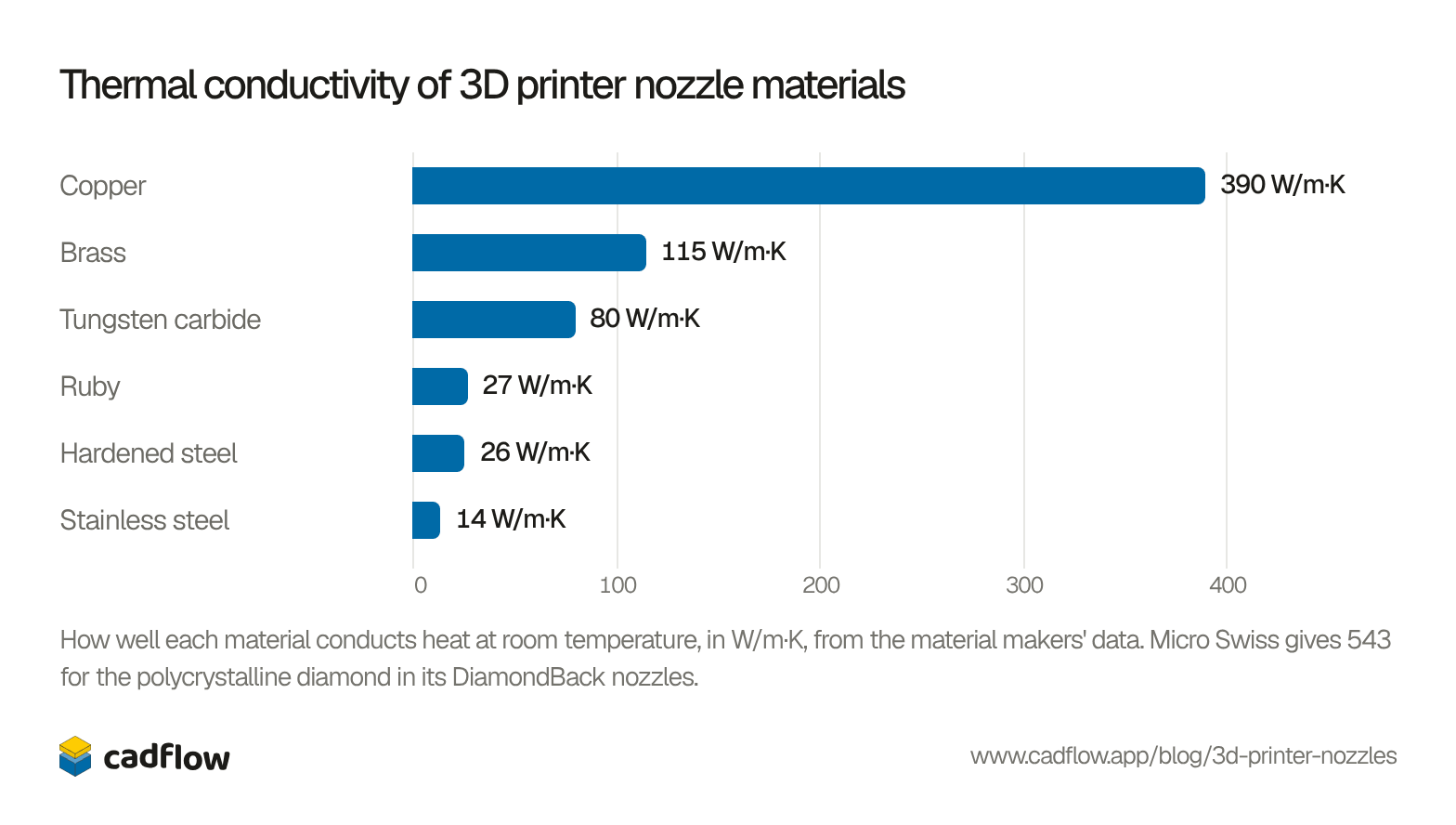
Hardened steel conducts heat about a quarter as well as brass, and stainless steel about an eighth as well. Less heat reaches the plastic on its way through, so Prusa prints 5 °C hotter with a hardened steel nozzle, and E3D about 10 °C hotter with its plated Nozzle X. E3D says its ObXidian, a copper body with a hardened steel insert, needs no change from brass.
Show as a table
| Material | Conducts heat |
|---|---|
| Copper | 390 W/m·K |
| Brass | 115 W/m·K |
| Tungsten carbide | 80 W/m·K |
| Ruby | 27 W/m·K |
| Hardened steel | 26 W/m·K |
| Stainless steel | 14 W/m·K |
How fast abrasive filament wears a nozzle
The fibres in carbon and glass fibre filament are harder than brass, and so is the pigment that makes filament glow in the dark. They grind the nozzle as they pass. E3D ran 250 g of colorFabb’s XT-CF20, a carbon fibre filament, through a new 0.4 mm brass nozzle, and the nozzle came out with a domed tip and a hole that was wider and no longer round. A hardened steel nozzle showed no wear after 2.5 kg of carbon and glass fibre filament.
CNC Kitchen found that the hole isn’t the first thing to go. After 360 g of the same XT-CF20 through a cheap brass nozzle the hole had barely grown, but the tip had worn shorter. A shorter nozzle sits higher above the bed, so the first sign of wear is a first layer that prints too high, followed by stringing and holes in the print. Olsson’s photos of its own test show the same, measured on the tip:
| Nozzle | Carbon fibre filament printed | Tip worn away |
|---|---|---|
| Brass | 0.3 kg | 0.5 mm |
| Stainless steel | 1 kg | 0.5 mm |
| Hardened steel | 4 kg | 0.18 mm |
| Ruby tip | More than 8 kg | None to see |
Olsson sells the ruby nozzle, so read that last row as the maker’s own result. No one has published a test like it for tungsten carbide or diamond yet.
Glow-in-the-dark filament varies more than you’d guess. CNC Kitchen printed 100 g of each of four brands through brass nozzles, in a dense infill that rubs the tip on every pass. colorFabb’s glowFill took almost half a millimetre off the tip, Tronxy’s 0.18 mm and Amolen’s sparkle green 0.1 mm, while dasFilament’s left almost nothing to measure.
When the first layer starts coming out thin or too high and lines get uneven, take the nozzle out and look at it. A worn one has a tip rounded into a dome, and often a hole that’s bigger or oval, as E3D’s cut-open nozzle had. It’s cheaper to swap a brass nozzle then to chase the problem in the slicer.
Screw-in and quick-swap nozzles
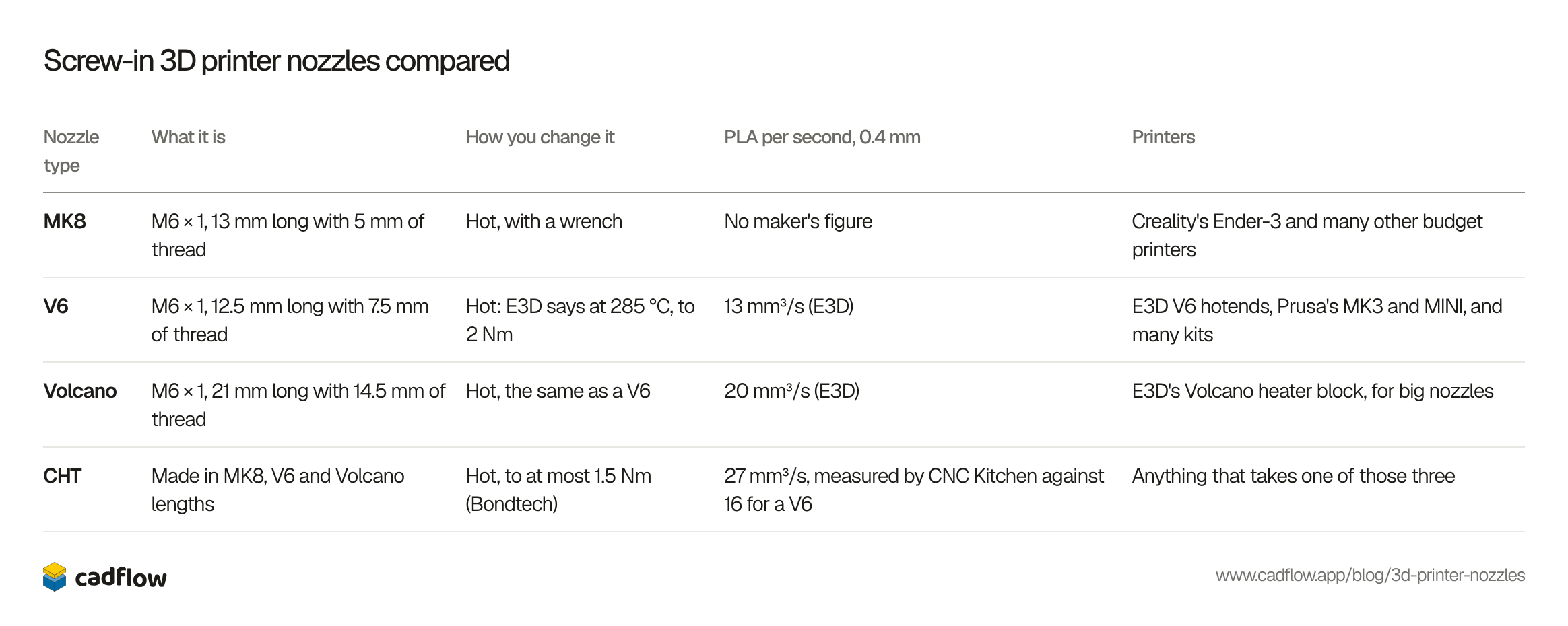
Older and cheaper printers take a nozzle that screws into the heater block. Most of these are M6 × 1, but they aren’t all the same length, so a nozzle only fits the hotend it was made for: an MK8 nozzle is 13 mm long with 5 mm of thread, a V6 nozzle 12.5 mm with 7.5 mm. Screw-in nozzles are tightened hot. E3D heats the hotend to 285 °C and tightens to 2 Nm, and Bondtech says at most 1.5 Nm for its CHT.
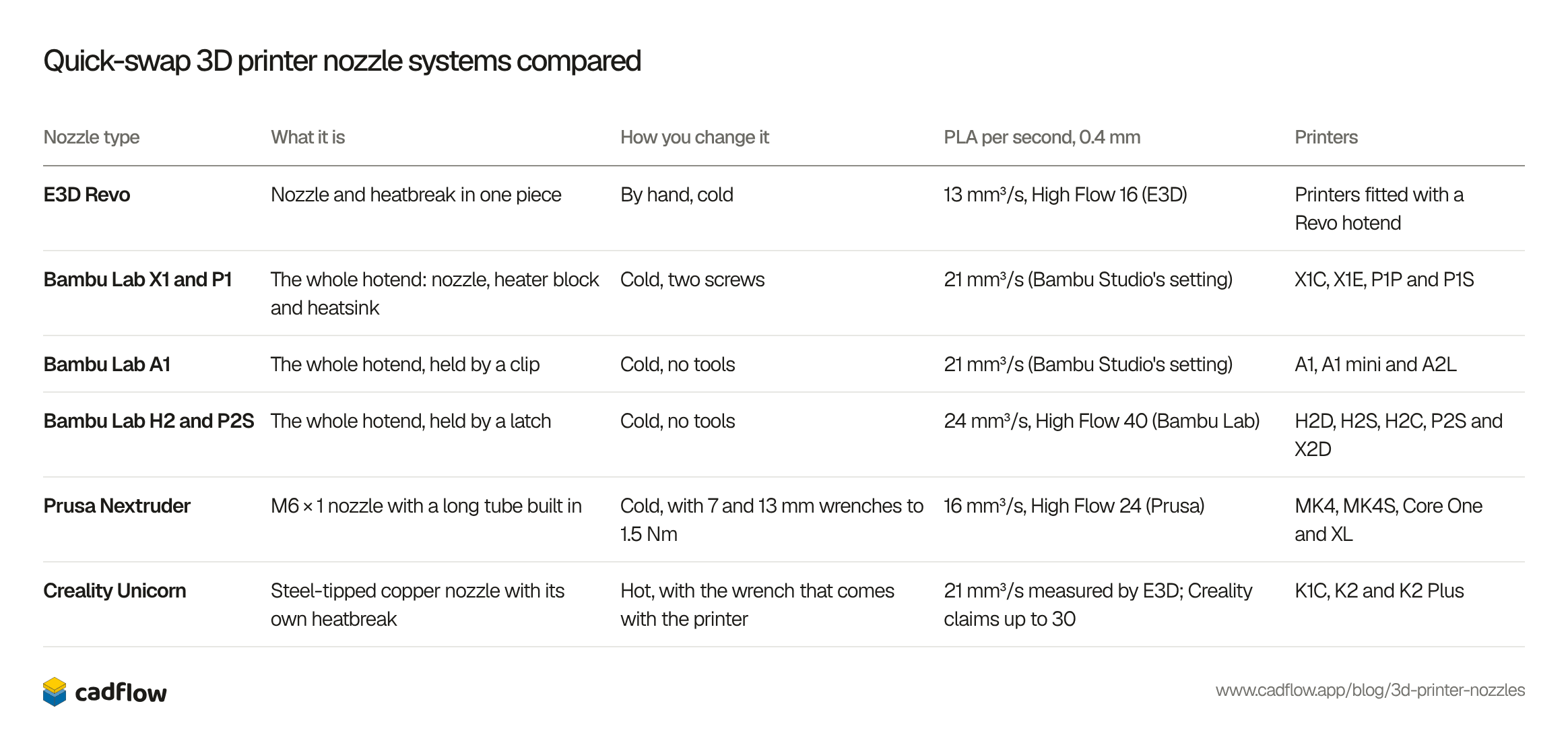
Newer printers mostly change the nozzle together with its heatbreak, or the whole hotend, cold and without tools. The flow column mixes makers’ figures, slicer settings and measurements, so each cell names whose number it is.
| Nozzle type | What it is | How you change it | PLA per second, 0.4 mm | Printers |
|---|---|---|---|---|
| MK8 | M6 × 1, 13 mm long with 5 mm of thread | Hot, with a wrench | No maker's figure | Creality's Ender-3 and many other budget printers |
| V6 | M6 × 1, 12.5 mm long with 7.5 mm of thread | Hot: E3D says at 285 °C, to 2 Nm | 13 mm³/s (E3D) | E3D V6 hotends, Prusa's MK3 and MINI, and many kits |
| Volcano | M6 × 1, 21 mm long with 14.5 mm of thread | Hot, the same as a V6 | 20 mm³/s (E3D) | E3D's Volcano heater block, for big nozzles |
| CHT | Made in MK8, V6 and Volcano lengths | Hot, to at most 1.5 Nm (Bondtech) | 27 mm³/s, measured by CNC Kitchen against 16 for a V6 | Anything that takes one of those three |
| Nozzle type | What it is | How you change it | PLA per second, 0.4 mm | Printers |
|---|---|---|---|---|
| E3D Revo | Nozzle and heatbreak in one piece | By hand, cold | 13 mm³/s, High Flow 16 (E3D) | Printers fitted with a Revo hotend |
| Bambu Lab X1 and P1 | The whole hotend: nozzle, heater block and heatsink | Cold, two screws | 21 mm³/s (Bambu Studio's setting) | X1C, X1E, P1P and P1S |
| Bambu Lab A1 | The whole hotend, held by a clip | Cold, no tools | 21 mm³/s (Bambu Studio's setting) | A1, A1 mini and A2L |
| Bambu Lab H2 and P2S | The whole hotend, held by a latch | Cold, no tools | 24 mm³/s, High Flow 40 (Bambu Lab) | H2D, H2S, H2C, P2S and X2D |
| Prusa Nextruder | M6 × 1 nozzle with a long tube built in | Cold, with 7 and 13 mm wrenches to 1.5 Nm | 16 mm³/s, High Flow 24 (Prusa) | MK4, MK4S, Core One and XL |
| Creality Unicorn | Steel-tipped copper nozzle with its own heatbreak | Hot, with the wrench that comes with the printer | 21 mm³/s measured by E3D; Creality claims up to 30 | K1C, K2 and K2 Plus |
Which nozzles we’d keep in the drawer
Keep a spare of the 0.4 mm nozzle your printer came with. In our opinion the one worth adding is a 0.6 mm hardened steel nozzle: Prusa calls the 0.6 the first extra nozzle to buy, and Bambu Lab suggests a 0.6 mm hardened steel nozzle for carbon and glass fibre filament, so one nozzle covers big parts and fibre-filled filament alike. A 0.2 or 0.25 mm nozzle is only worth it if you print miniatures or small text, and you’ll want alot of patience for those prints.
About CadFlow
We make CadFlow, a 3D program for things you build, which plays the build back as a step-by-step video that anyone can follow. It isn’t public yet. If you'd like to try it, join the waitlist.
Questions people ask
What size nozzle does my printer have?
Almost certainly 0.4 mm. It's the nozzle Prusa, Bambu Lab and most other makers fit as standard, and it's what slicer profiles start from.
Can I print PLA with a hardened steel nozzle?
Yes. Print about 5 to 10 °C hotter than you would with brass, because hardened steel conducts heat worse. Bambu Lab's 0.4 to 0.8 mm hotends for its X1, P1 and H2 printers are hardened steel, and they print PLA every day.
Can I print carbon fibre filament through a 0.2 mm nozzle?
No. Bambu Lab says the fibres are often longer than 0.2 mm and clog it quickly, and its 0.2 mm nozzle is stainless steel, which wears too. Use a hardened steel nozzle of 0.4 mm or, better, 0.6 mm.
How often should I change my nozzle?
It depends on the filament, not on time. With carbon fibre filament, brass nozzles were worn after 250 to 360 g in E3D's and CNC Kitchen's tests. Change it when the first layer starts printing too high or thin, or the tip looks rounded.
Is a brass nozzle food safe?
E3D says brass has a little lead in it, and makes stainless steel nozzles for food and medical use. The printed part matters as much as the nozzle: our filament post has what Polymaker and Prusament say about food-safe prints.
What's the difference between MK8 and V6 nozzles?
Both screw in with an M6 × 1 thread, but an MK8 nozzle is 13 mm long with 5 mm of thread and a V6 nozzle 12.5 mm with 7.5 mm, so each fits only its own hotend. MK10 nozzles have an M7 thread and fit neither.
Where do the numbers come from?
We read these on 8 November 2026. Sizes: Bambu Lab's nozzle guide and 0.2 mm FAQ, Prusa's nozzle types and its post on nozzle sizes. Flow: E3D's V6 and Volcano tables and CNC Kitchen's CHT test and the Bambu Lab forum thread on 0.8 against 0.6 mm. Strength: CNC Kitchen's big nozzle test. Wear: E3D's test, CNC Kitchen's carbon fibre and glow-in-the-dark tests, and Olsson's. Materials and prices: each card links its source. Prices are for one 0.4 mm nozzle at the maker's or a big reseller's US store, before tax and at the regular price, as several stores were running Black Friday sales.
Free tools for this
History of this post
- Published
Read next
Types of 3D printers: FDM, resin, SLS, MJF, PolyJet and metal compared
The 8 most popular 3D printers for 2027, tested on the same part

Top 4 3D printer software for 2027 (three of them share one ancestor)


This blog is by the team making CadFlow, where you build your project in 3D and show how it goes together.
See how CadFlow works